
Brazilian Wedding Ceremony Etiquette for Guests
For a Brazilian or Brazilian-diaspora wedding, the invitation is more useful than a generic list of national customs. Expectations change with the couple's family, city, faith, venue, level of formality, and the traditions brought together at a diaspora celebration. Follow the stated time and dress code, clarify any assigned role, and check whether phones or cameras are welcome.
Do not assume guests should arrive late, every ceremony will be Catholic, or every wedding uses the same procession. Research identifies meaningful patterns in particular Brazilian settings, but it does not establish a nationwide etiquette code. For the event you are attending, instructions from the couple, coordinator, officiant, church office, or venue take priority.
More specific pages
These pages continue the topic in smaller, more specific directions.
Read the Invitation as an Event Plan
An invitation may communicate several decisions at once: the ceremony time, reception location, dress code, guest list, transportation arrangements, and RSVP method. Read the invitation, wedding website, and accompanying messages before relying on something you have heard about Brazilian weddings.
One persistent misunderstanding is that Brazilian ceremonies routinely begin late or that the bride is expected to delay her entrance. Delays may occur at individual events, but that does not make late guest arrival appropriate. A guest entering after the stated time can interrupt the procession, miss coordinator instructions, or find that access has been limited once the ceremony begins.
For Brazilian wedding arrival time, work through these points:
- Use the time stated by the couple.
- Check whether it means guest arrival or the start of the procession.
- Allow for traffic, parking, security, venue gates, and unfamiliar roads.
- Confirm shuttle departures separately from the ceremony time.
- Plan to find your seat before the procession begins.
Destination guests should leave extra room for local travel conditions. A route that looks short on a map may involve dense city traffic, rural access, limited parking, or a controlled venue entrance. If the schedule is ambiguous, ask a precise question: “What time should guests be seated?”
The invitation may distinguish the cerimônia from the festa, meaning the ceremony and the reception or wider celebration. The word festa does not reveal the gap between venues, meal time, transport schedule, or expected end time. Confirm those details when they affect childcare, accommodation, or the journey back.
Dress for the Actual Wedding
Brazilian wedding guest attire ranges from polished daytime clothing to formal evening wear. There is no single national rule for dress length, colors, jackets, or gala clothing. A stated Brazilian wedding dress code should take priority over broad descriptions of what guests supposedly wear in Brazil.
If the dress code is unclear, consider the variables in this order:
| Variable | What to check |
|---|---|
| Invitation wording | Any named level of formality or specific clothing request |
| Ceremony setting | Church, registry setting, beach, garden, hotel, or event venue |
| Time | Whether the ceremony and reception take place during the day or evening |
| Location and season | Conditions in the specific city or region rather than assumptions about Brazil as a whole |
| Weather and terrain | Heat, rain, humidity, wind, sun exposure, grass, and uneven ground |
| Host guidance | Clarification from the couple, coordinator, or wedding party |
Brazil is geographically large, and its seasons run opposite to those in the Northern Hemisphere. The calendar alone is still a poor packing guide because conditions differ by region and elevation. Check the forecast for the wedding location.
A religious venue may have expectations suited to its worship space, but these should not be converted into universal rules about sleeves, hemlines, head coverings, or footwear. Ask the couple or the relevant church office when the invitation does not provide enough detail. At an outdoor secular ceremony, weather and terrain may matter more than a generalized standard of formality.
Guests also sometimes worry about matching the attendants. Do not assume Brazilian attendants always wear one color, never coordinate, or reserve a particular palette. Follow any request from the couple about colors to wear or avoid. Without such a request, the setting and stated formality are better guides than commercial lists of wedding traditions.
Understand Assigned Roles and Reserved Spaces
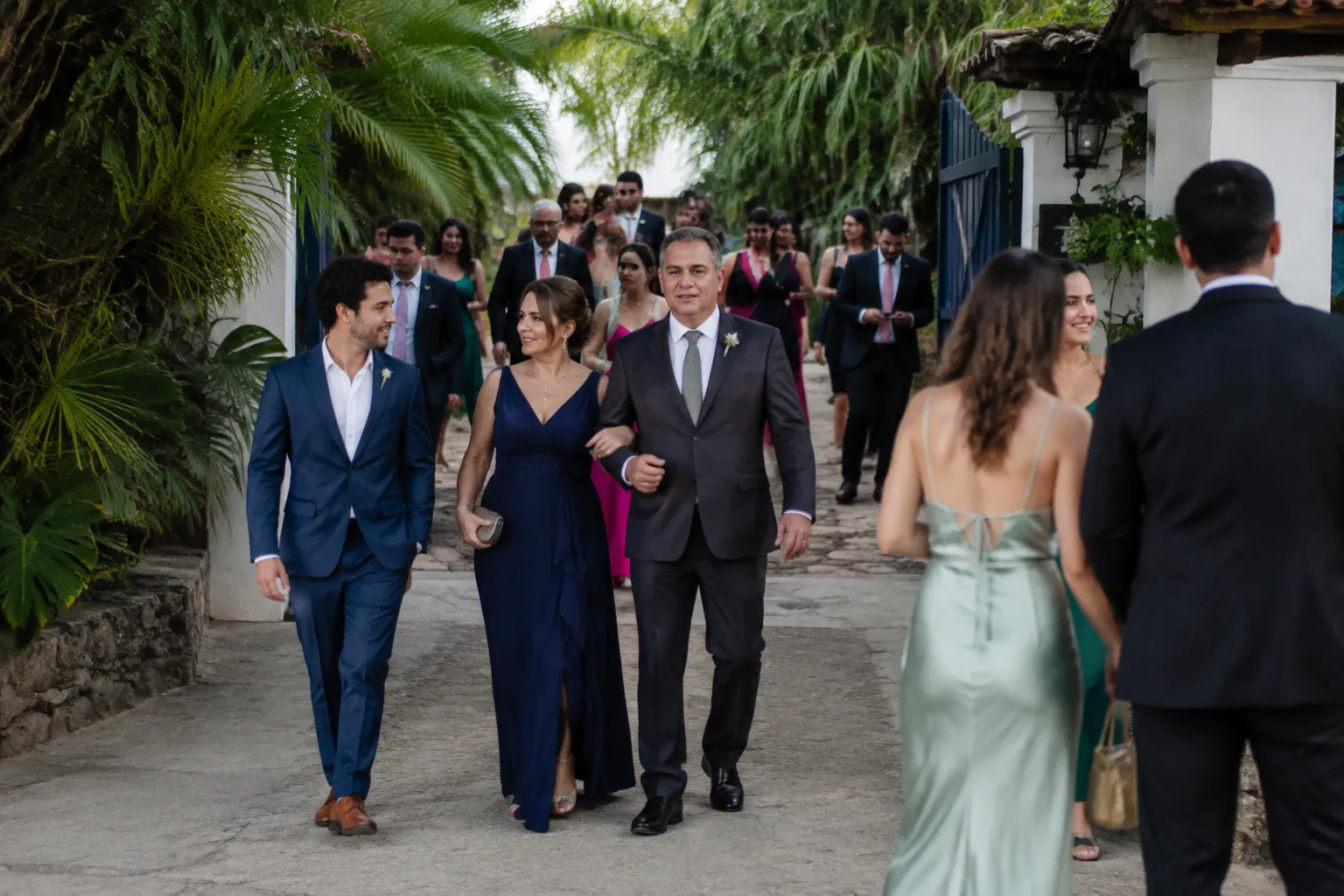
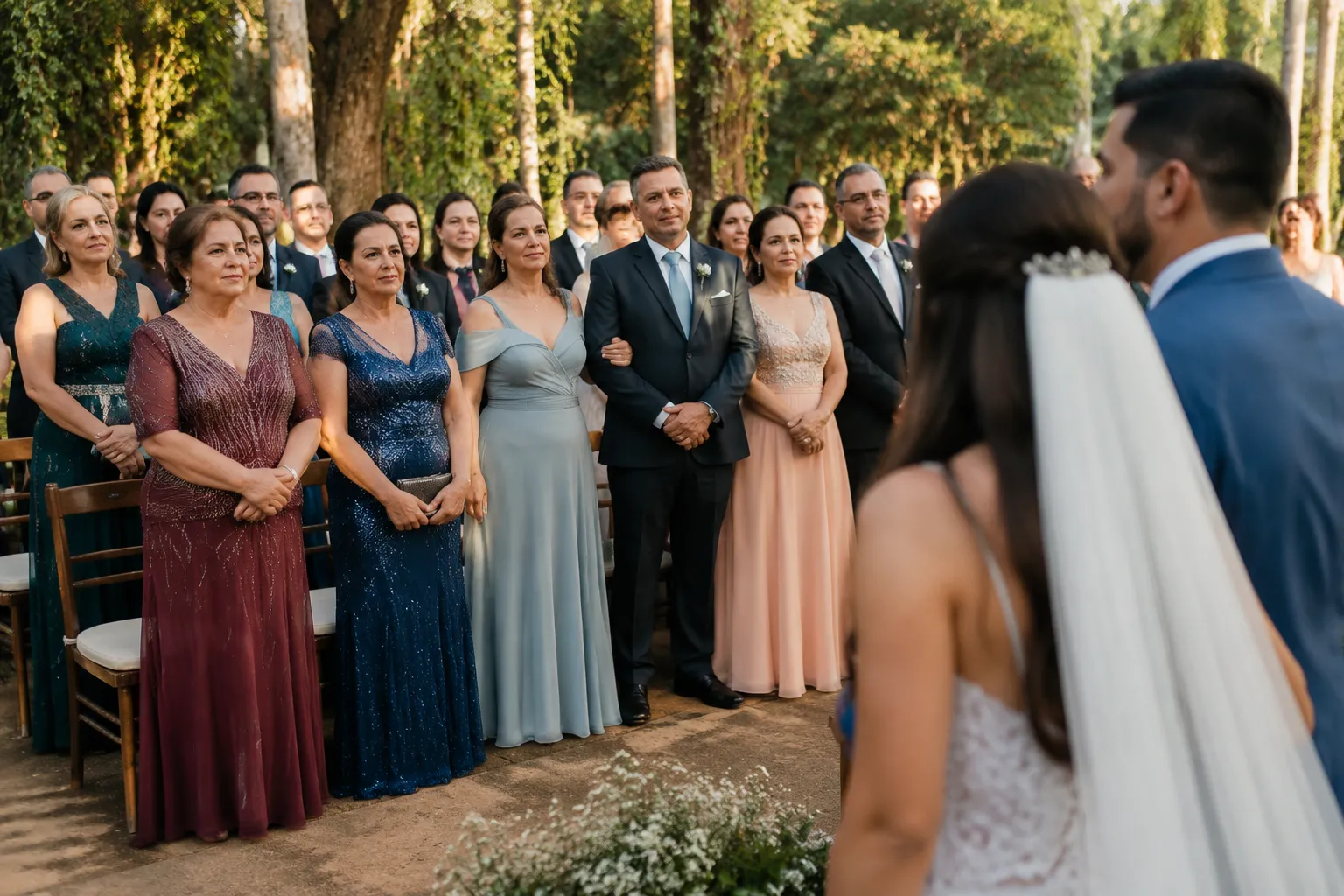
For international guests, one important distinction is the place of padrinhos and madrinhas. They are honored participants or witnesses selected by the couple, but their roles do not map neatly onto a single best man and maid of honor.
The number of participants, pairing, clothing, procession order, and position can vary. Some enter as couples; others may be relatives or close friends. Depending on the ceremony, they may stand near the couple, sit behind family members, or occupy reserved rows. Brazilian research on Catholic ceremony space documents deliberate arrangements for processions, readings, seating, and participant positions in the ceremonies studied. This helps explain why an empty seat, waiting group, or open section near the front may be part of the plan rather than available space.
Ethnographic research on wedding organization also describes how the selection of padrinhos and madrinhas may express affection, kinship, reconciliation, or family negotiation. An invitation to the role can therefore carry social meaning beyond the visible ceremony duties.
For an ordinary guest, the practical rule is straightforward: do not occupy a reserved row, join a procession, or enter the ceremony area unless directed. If you are asked to be a padrinho, madrinha, reader, escort, witness, or another participant, clarify the assignment before the wedding:
- Where and when should you meet the coordinator?
- Will you enter in a procession?
- Is clothing assigned or is there a color direction?
- Will you sit, stand, read, sign, or respond during the ceremony?
- Will instructions be given in Portuguese, English, or both?
- Is there a rehearsal or another preparation step?
Questions involving participation in a religious rite, witnessing, or civil paperwork should go to the couple and the relevant local office. The social importance of the invitation does not determine its procedural meaning.
Follow the Ceremony's Religious, Secular, and Language Cues
Brazilian religious ceremony etiquette is not interchangeable with Catholic etiquette, and Brazilian weddings are not all religious. Guests may encounter Catholic, Protestant, Jewish, Muslim, interfaith, secular, civil, or family-designed ceremonies. A diaspora wedding may combine Brazilian terms and family customs with practices from another country or community.
At a religious ceremony, follow the visible and spoken cues. Stand, sit, sing, or respond when guests are invited and when you are comfortable doing so. If part of the ceremony is intended for members of that faith or designated participants, remain respectfully in place. The program, officiant, and local worship community are more useful guides than assumptions based on another wedding.
Studies of Brazilian Catholic ceremonies describe structured processions, readings, a homily, consent, and an exchange of rings in the settings examined. These elements may help a visitor recognize the flow, but their order, length, music, and participant roles can differ. Keep aisles and reserved ritual areas clear even when you do not understand every instruction.
A secular ceremony may still have an organized entrance, readings, family participation, vows, and designated witnesses. “Secular” does not mean informal or open to spontaneous participation. Wait for the celebrant or coordinator to invite a response.
Plan for the Ceremony Language
If the ceremony will be mainly in Portuguese and you do not speak it, ask in advance whether there will be a bilingual program, translated summary, interpreter, or bilingual celebrant. Do not assume translation will be provided unless the hosts have arranged it.
- Noiva and noivo: the traditional Portuguese terms for bride and groom.
- Padrinhos and madrinhas: honored participants or witnesses whose duties vary by event.
- Cerimônia: ceremony.
- Festa: reception or celebration.
- Cartório: registry office; questions about local civil procedures belong with the specific office involved.
Family participation may be highly visible without following a fixed Brazilian script. Research across different Brazilian social settings describes variation in planning labor, spending, family contribution, geography, and access to wedding services. For a guest, the useful conclusion is not to classify the event but to watch how this couple has assigned roles and spaces.
Can Guests Take Photos During a Brazilian Wedding Ceremony?
Sometimes, but permission is specific to the event. There is no well-supported nationwide set of Brazilian wedding photography rules for guests. A couple may welcome discreet phone photos, request an unplugged ceremony, restrict photography during selected moments, or leave ceremony coverage to the hired team. The celebrant, church, or venue may set additional conditions for that location.
Treat an unplugged request according to the timing stated by the hosts. It may cover the entire ceremony, only the procession, or a period before the couple shares its own images. Ask when the wording is unclear instead of choosing the most permissive interpretation.
When guest photography is welcome:
- Silence the phone completely.
- Remain seated or within the designated guest area.
- Keep aisles, entrances, and procession routes clear.
- Do not raise a device where it blocks another guest's view.
- Avoid flash unless permission is clear.
- Do not approach the couple during vows, consent, rings, or other central moments.
- Do not follow the hired photographer into restricted positions.
Access arranged for a professional photographer does not automatically extend to guests. Photographer guidelines issued by individual parishes show how rules about position, movement, flash, and timing can belong to one building or ceremony rather than to Catholic weddings generally.
When no photography guidance has been given, keeping the device away during the procession and central ceremony moments avoids obstructing the event. Photos can wait until the couple, coordinator, or officiant indicates that they are welcome.
A Practical Check Before You Go
Most uncertainty can be resolved by checking the invitation and identifying the few unanswered questions that affect your conduct.
- What time should guests be seated?
- Is transportation arranged between the ceremony and reception?
- What is the dress code for this venue and weather?
- Will the ceremony be in Portuguese, another language, or both?
- Are any rows or ceremony areas reserved?
- Are guest photographs welcome, limited, or excluded?
- If you have an assigned role, where and when do you receive instructions?
The central distinction in Brazilian wedding ceremony etiquette is between a reported possibility and an instruction for this event. A wedding may be formal, strongly family-oriented, mainly in Portuguese, followed by an extended festa, or adapted across Brazilian and diaspora traditions. None of those possibilities tells a guest to arrive late, occupy a reserved row, join a ritual, or take a photograph without checking. Start with the couple's plan, then pay attention to the people directing the ceremony once you arrive.
Sources
- Espacialidade dos Rituais em Cerimônias de Casamentos Católicos: Uma Abordagem Comparativa entre Brasil e França
- Festa da noiva? Conflito, gênero e parentesco numa etnografia sobre a organização de casamentos
- Formal Attire from One Side of the “Bridge” to the Other: The Wedding Market and Class and Gender Relations Inscribed in the Territory of the City
- “Um sonho não tem preço”: uma etnografia do mercado de casamentos no Brasil
- Guidelines for Wedding Photographers – Our Lady of Grace Catholic Church
- Parish Policies for Wedding Ceremonies | Our Lady of Lourdes