
Guest planning guide
Brazilian Wedding Guest Guide: Etiquette, Attire, and Gifts
Brazilian wedding etiquette starts with the invitation, not a fixed list of national customs. Confirm which events you are invited to, reply through the stated channel, follow the dress code, use any supplied gift list, and arrive at the requested time. During the ceremony and festa, take your cues from the program, hosts, and venue.
You may encounter terms such as padrinhos, madrinhas, festa, and bem-casados. They provide useful cultural context, but they do not tell you exactly how a particular wedding will work. Region, family, faith, venue, and the couple’s preferences all shape the event. Brazilian-diaspora weddings may also combine or adapt traditions from more than one country.
Explore this topic
These pages continue the topic in smaller, more specific directions.
Read the Invitation as an Event Plan
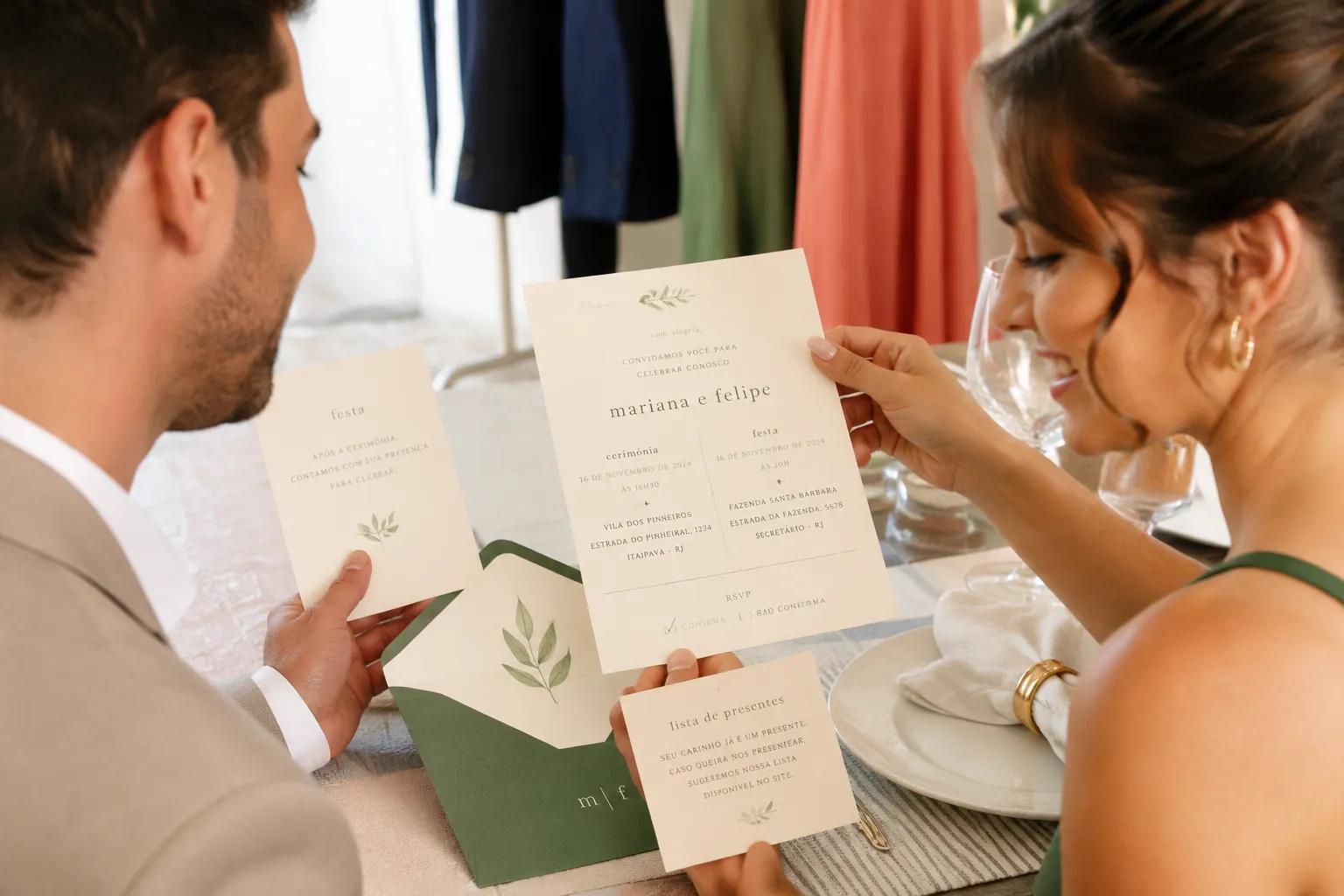
A Brazilian wedding invitation may cover one event or a sequence of gatherings. Read the full invitation, open any linked wedding website, and note whether different dates, times, or locations are listed.
Common Portuguese terms
Casamento
Wedding or marriage, depending on context.
Cerimônia
Ceremony.
Cerimônia religiosa
Religious ceremony.
Festa or festa de casamento
Reception or wedding celebration.
Cartório de Registro Civil
Civil registry, usually relevant to the couple’s administrative arrangements rather than an ordinary guest’s plans.
Padrinhos and madrinhas
Honored participants whose responsibilities are set by the couple.
Lista de presentes
Gift list or registry.
A civil appointment, religious ceremony, and reception may be separate. An invitation to one does not necessarily include the others. A civil event might be limited to close relatives and witnesses, followed by a larger celebration, but couples can arrange their guest lists in many other ways.
Use the invitation to establish the practical details before booking travel or choosing clothes:
| Invitation detail | What to determine |
|---|---|
| Names and household | Whether partners or children are included |
| Event scope | Which ceremonies, celebrations, or additional gatherings you may attend |
| Dates and times | The start or requested arrival time for each event |
| Locations | Separate addresses for the ceremony and reception |
| RSVP | Deadline, response channel, and requested information |
| Attire | Dress code and any role-specific instructions |
| Gifts | Registry link, delivery method, or designated contact |
| Transportation | Parking, shuttle points, transfers, and return arrangements |
| Wedding website | Schedule updates, maps, lodging information, and contact details |
There is no single invitation format, RSVP channel, dress formula, gift system, or reception schedule that applies across Brazil. When general wedding advice conflicts with the invitation or a direct message from the hosts, follow the event-specific instructions.
Ask a Narrow Question
When something is unclear, ask about the decision you actually need to make:
- “Does our invitation include both the ceremony and the reception?”
- “Is 5:00 p.m. the requested arrival time or the ceremony start?”
- “Is the dress code the same at the church and the reception?”
- “Are children included in our invitation?”
- “Will transportation return to the hotel after the festa?”
- “Can international guests use the gift list?”
- “I am a madrinha. Is there a color or length specified for my outfit?”
Use the planner, family contact, or wedding-party coordinator if the couple has named one. This is particularly helpful at diaspora weddings, where wording and expectations may reflect several family traditions.
RSVP Clearly and on Time
Use the response method provided by the hosts, whether that is a wedding website, form, email, messaging contact, telephone number, or planner. Reply by the deadline even when some travel details remain unsettled. If you cannot give a final answer, explain what is unresolved and when you expect to know.
A complete response usually confirms:
- The name of each attending guest.
- Acceptance or decline.
- Attendance at each listed event, if requested separately.
- Dietary or accessibility information requested by the hosts.
- Shuttle, accommodation, or transport selections.
- A reliable contact number for schedule changes.
Do not add a companion or child unless the invitation includes them. If the household wording is ambiguous, ask before submitting the response.
At a multi-event wedding, accepting or declining one gathering may not answer for the rest. State your plans for each event rather than expecting the hosts to infer them.
Destination guests may face a timing problem: the RSVP deadline can arrive before flights or lodging are finalized. Check whether the hosts want an initial attendance response followed by travel details. If plans change after the deadline because of illness, a disrupted journey, or another serious problem, contact the host or coordinator promptly rather than passing the message through another guest.
For invitation wording, plus-one questions, children, attendance scope, and response channels, the next topic is Brazilian Wedding Invitations and RSVP Etiquette.
Choose Attire by Dress Code, Setting, and Role
Brazilian wedding guest attire cannot be reduced to a national color rule or garment formula. Start with the written dress code, then account for the venue, city, season, time of day, weather, ceremony setting, and your role.
Claims such as “never wear black,” “all women wear long dresses,” or “beach weddings are always relaxed” are too broad to guide a real invitation. A beachfront wedding can be formal, and an urban event may be less formal than its setting initially suggests.
Use this order:
- 1. Follow the invitation or wedding website.
- 2. Check for separate instructions if you have a ceremony role.
- 3. Consider expectations at a church or other place of worship.
- 4. Account for the venue surface, weather, temperature changes, and walking distance.
- 5. Ask the designated contact if the wording remains unclear.
Ordinary guests should avoid clothing that appears intended to compete with the couple or the coordinated wedding party. More precise restrictions should come from the hosts rather than a supposed rule for all Brazilian weddings.
Ordinary Guests and Honored Participants
Do not copy the clothing of the padrinhos or madrinhas unless you have been asked to do so. These honored participants may receive specific directions about colors, fabrics, accessories, or formality.
If you have been invited to serve as a padrinho or madrinha, confirm:
- Which events include your participation.
- What clothing or accessories are expected.
- Where and when to meet before the ceremony.
- Whether you will enter in a procession.
- Whether you will be paired or grouped with anyone.
- Where you will stand or sit.
- When you are needed for photographs.
These terms do not map neatly onto “bridesmaid,” “groomsman,” “maid of honor,” or “best man.” A couple may have several honored pairs or groups, and their placement and responsibilities can differ from those of an Anglo-American wedding party. The title is therefore the beginning of the briefing, not a complete role description.
Dress for the Physical Venue
For an outdoor event, determine whether you will cross sand, grass, stone, stairs, or long pathways. Check whether the ceremony and reception share a venue and whether each space is air-conditioned, open-air, or exposed to evening weather.
Expressions such as “beach formal” still require interpretation within the specific event. Footwear suitable for a hotel terrace may be impractical on loose sand, while an outfit chosen for an afternoon ceremony may need an additional layer after dark.
Use a date-specific forecast for the wedding city. Brazil covers a wide range of climates, so conditions reported for one destination are not a dependable packing guide for another.
Understand the Ceremony Before You Arrive
Brazilian weddings may be civil, religious, secular, mixed-faith, or shaped by customs from several countries. Catholic traditions influence some weddings, but the venue name or the couple’s instructions are a better guide than assumptions about faith.
The invitation may identify the ceremony type directly. If it does not, check the venue and ask whether it is a church, another worship setting, a civil location, or a secular event space.
At a religious ceremony, follow the program, officiant, ushers, and nearby family members. Expectations can vary even within the same faith tradition. Useful guest habits include:
- Arrive early enough to be seated before the entrance.
- Silence your phone.
- Respect restrictions on photography, flash, or video.
- Keep out of altars, platforms, and other restricted areas.
- Follow local cues about standing, sitting, or remaining still.
- Refrain from joining a religious practice if you are unsure whether participation is appropriate.
- Wait for an usher or host to direct movement after the ceremony.
Questions about clothing, seating, photography, or participation in a religious rite should go to the hosts or the relevant religious office. These details cannot be inferred from a general description of Brazilian church weddings.
Civil and Religious Events May Be Separate
A schedule may distinguish a civil event from a religious or social ceremony. That distinction helps guests understand where and when to appear; it does not invite conclusions about the couple’s civil status or the legal effect of a particular gathering.
Terms such as Cartório de Registro Civil and habilitação concern couple-facing administrative processes. A guest normally needs only to know whether a civil event appears on the invitation. Questions about local registry procedures belong with the specific civil registry, while questions about religious participation belong with the hosts and religious office.
Arrive at the Requested Time and Track the Full Schedule
The recurring stereotype that lateness is expected at a Brazilian wedding is not a useful instruction for guests. Treat the invitation time as operative. If it could mean either “doors open” or “ceremony begins,” ask the host or coordinator.
A church, hotel, gated venue, or private property may require extra time for parking, security, check-in, walking, and seating. Plan backward from the requested arrival:
- 1Identify the correct guest entrance.
- 2Confirm parking, drop-off, or shuttle times.
- 3Allow for local traffic and transfers.
- 4Add time for security, access, and walking.
- 5Be seated before the procession or any stated access cutoff.
For a two-location wedding, check the journey from the ceremony to the reception in advance. Do not assume transportation is provided. When it is, record the pickup point, departure time, and late-night return arrangements.
A wedding itinerary may also include a welcome gathering, family meal, transport window, next-day event, or separate ceremony. These are possibilities rather than a standard Brazilian sequence. Keep one personal schedule with:
- Local date and time for every event.
- Full addresses and map links.
- Host or coordinator contact details.
- Shuttle and transfer information.
- Attire for each setting.
- Gift or card arrangements.
- Hotel check-in and checkout times.
- Return transportation from late events.
- Flight, train, or bus details.
Share essential logistics with your companion, but keep private invitation information within the invited group.
Give According to the Couple’s Instructions
If the couple provides a lista de presentes or registry, use the supplied link and delivery directions. Registry platforms may depend on local payment methods, addresses, or delivery conventions, which can cause problems for guests purchasing from abroad. Contact the designated organizer if a foreign card, billing address, currency, or delivery field is not accepted.
When no gift guidance appears, ask discreetly: “Is there a gift list or a preferred way to send something?” This is more reliable than guessing whether the couple expects a physical present, money, a group gift, or no gift at all.
Before purchasing, check:
- That the link came from the couple or their wedding website.
- Whether the gift is delivered directly or collected elsewhere.
- Whether the platform records the giver’s name.
- Whether you can include a message.
- Whether international payment and delivery are supported.
- Whether the hosts have asked guests to bring anything to the venue.
Avoid carrying a large physical gift to the ceremony unless requested. The venue may not have a gift table, secure storage, or a practical way to transport packages after the event.
There is also no dependable nationwide formula for a gift amount based on the venue, your relationship to the couple, or the number of people in your household. Choose within your means and from the options the couple provides. If you cannot use the registry, ask about an alternative rather than assuming cash is expected.
For a closer look at international payments, delivery, group gifts, and weddings without a stated registry, continue to Brazilian Wedding Gifts, Registries, and Giving Etiquette.
Join the Festa Without Expecting a Fixed Script
Festa or festa de casamento refers to the reception or wedding celebration. Guests may encounter entrances, family photographs, speeches, a seated meal, food served in stages, sweets, music, and dancing. Their order and prominence depend on the couple, family, venue, and style of celebration.
Follow announcements and read the room. One reception may move quickly into mingling and dancing, while another follows a formal sequence. Brazilian wedding reception customs should not be treated as a universal timetable.

Good participation means being attentive without assuming that you must perform, dance, or remain until the final song:
- Be present for entrances and announcements when requested.
- Follow seating directions during a planned meal.
- Give the couple and designated groups room to complete photographs.
- Join the dance floor if you are comfortable.
- Keep service routes and the photographer’s working area clear.
- Arrange late-night transportation before the reception is underway.
- Say goodbye when practical if you leave early.
Food may be served at several points rather than in a single dinner-and-cake sequence. If timing affects dietary needs, childcare, transport, or another important arrangement, ask for the actual event schedule.
Not every Brazilian reception is exceptionally large, centered on one music style, spread across several days, or planned to continue until morning. Those images appear frequently in promotional wedding content, but they do not predict an individual event.
Bem-Casados, Photos, and Departure
Guests may encounter bem-casados, paired sweets commonly associated with weddings and often described as symbols of the couple’s union. They may be wrapped as favors or displayed near the exit.
Their presentation and distribution vary. Do not assume they will appear at every wedding or that their appearance signals the formal end of the reception. If the display includes instructions, take only the intended quantity.
Formal photography may involve extended family and groups of padrinhos and madrinhas. Remain nearby if you have been told that you are needed, move into position promptly, and avoid standing in the photographer’s working area.
Follow any social-media preference set by the couple. In the absence of explicit instructions, avoid posting ceremony images, revealing significant details before the couple, or obstructing another guest’s view with a phone.
For more about reception flow, food, dancing, favors, photography, and departure decisions, see Brazilian Wedding Festa Etiquette and Participation.
Plan Destination Travel Around the Actual City and Itinerary
Destination planning depends on the traveler’s nationality, route, airline, event city, and dates. No single travel-document or packing checklist works for every guest.
Brazil’s National Civil Aviation Agency, ANAC, directs passengers to verify the documents applicable to their journey and circumstances. Airlines also check documentation during travel. Before making nonrefundable arrangements, review current government or consular information for your nationality and confirm requirements with every airline operating your route.
The U.S. Department of State publishes current Brazil information for U.S. travelers. Its notices are written for a defined audience and should not be generalized to visitors of other nationalities.
Wedding blogs, visa sellers, old forum posts, and personal accounts are not reliable sources for entry conditions, permitted stays, fees, passport rules, or processing times. Those details may change and can depend on nationality, purpose, transit points, and travel dates.
Build a Door-to-Door Plan
Your itinerary should cover more than the flight into Brazil:
| Travel question | What to confirm |
|---|---|
| Arrival | Airport, terminal, and onward transfer |
| Lodging | Check-in, checkout, luggage storage, and distance from events |
| Wedding transport | Shuttle stops, departure times, and included events |
| Independent transport | Parking, drivers, local services, and late-night availability |
| Connectivity | Mobile service and offline access to maps and addresses |
| Timing | Time-zone differences and local reminders |
| Additional gatherings | Which events are included in your invitation |
| Backup plan | A contact for missed shuttles, delayed flights, or driver problems |
Return transportation deserves particular attention when the reception ends late or the venue is outside a central area. Arrange it in advance if the hosts are not providing a service.
Pack for the wedding city, season, and physical venue rather than for a generalized idea of Brazilian weather. A practical event kit may include venue-appropriate footwear, a weather-appropriate layer, compact rain protection when relevant, essential personal items, offline addresses, and any clothing or accessories required for your role.
Keep document copies separately from the originals as a practical backup, while relying on current authorities and the airline to determine what you need to carry.
For lodging, transfers, packing, multi-event schedules, and document-confirmation steps, continue to Brazilian Wedding Travel and Schedule Guide for Guests.
A Brazilian Wedding Guest Decision Map
Use this map to separate what the hosts have already decided from what still needs clarification:
| Guest decision | Start with | Confirm with |
|---|---|---|
| Who is invited | Names and household wording | Couple or RSVP contact |
| Which events to attend | Invitation itinerary | Host or planner |
| How to RSVP | Stated response channel | RSVP contact |
| What to wear | Dress code, role, and venue | Couple, role coordinator, or venue |
| What an honored role involves | Personal role message | Couple or ceremony coordinator |
| How to behave in worship | Program and site directions | Hosts or relevant religious office |
| When to arrive | Invitation time | Venue or coordinator if ambiguous |
| What to give | Registry or gift note | Couple or designated contact |
| How the festa will run | Wedding website or program | Planner or host |
| How to travel | Current traveler-specific information | Government source, consulate, airline, and transport provider |
| What documents to carry | Nationality, route, and current rules | Relevant authorities and airline |
| What weather to expect | City, season, and event date | Current local forecast |
The useful hierarchy is consistent: read the invitation closely, ask precise questions, follow instructions from the venue or ceremony site, and use broad descriptions of Brazilian weddings as context rather than commands. That leaves room for regional and family differences, as well as diaspora weddings that combine, shorten, or reinterpret traditions.
The cultural sections above reflect commonly described practices rather than a documented nationwide rulebook. Public sources available for this guide provide stronger support for travel-document boundaries than for claims about universal invitation, attire, gift, ceremony, or reception customs. The couple’s instructions remain the most useful source for the event you will actually attend.
Sources
Sources and further reading
Reference links are limited to sources considered suitable for public citation in this page.