
Planning overview
Destination Wedding Planning in Brazil
A Brazil destination wedding works best as one connected plan, not a local ceremony with travel added later. The location affects airport access, accommodation, vendor availability, weather protection, guest movement, attire, photography, and the time available for each part of the celebration. The ceremony model also matters: a symbolic celebration, religious ceremony, civil process in Brazil, and registration of a marriage celebrated abroad are separate planning situations.
Start by asking a practical question: can the destination support the ceremony, guests, vendors, transport routes, and backup arrangements you need? From there, assign decision owners, identify what must be confirmed locally, and build the timeline around dependencies rather than a generic countdown.
Civil and religious procedures vary by office, location, and the couple's circumstances. Use this article to prepare questions, then confirm the applicable process with the specific cartório, church office, venue, or other responsible organization.
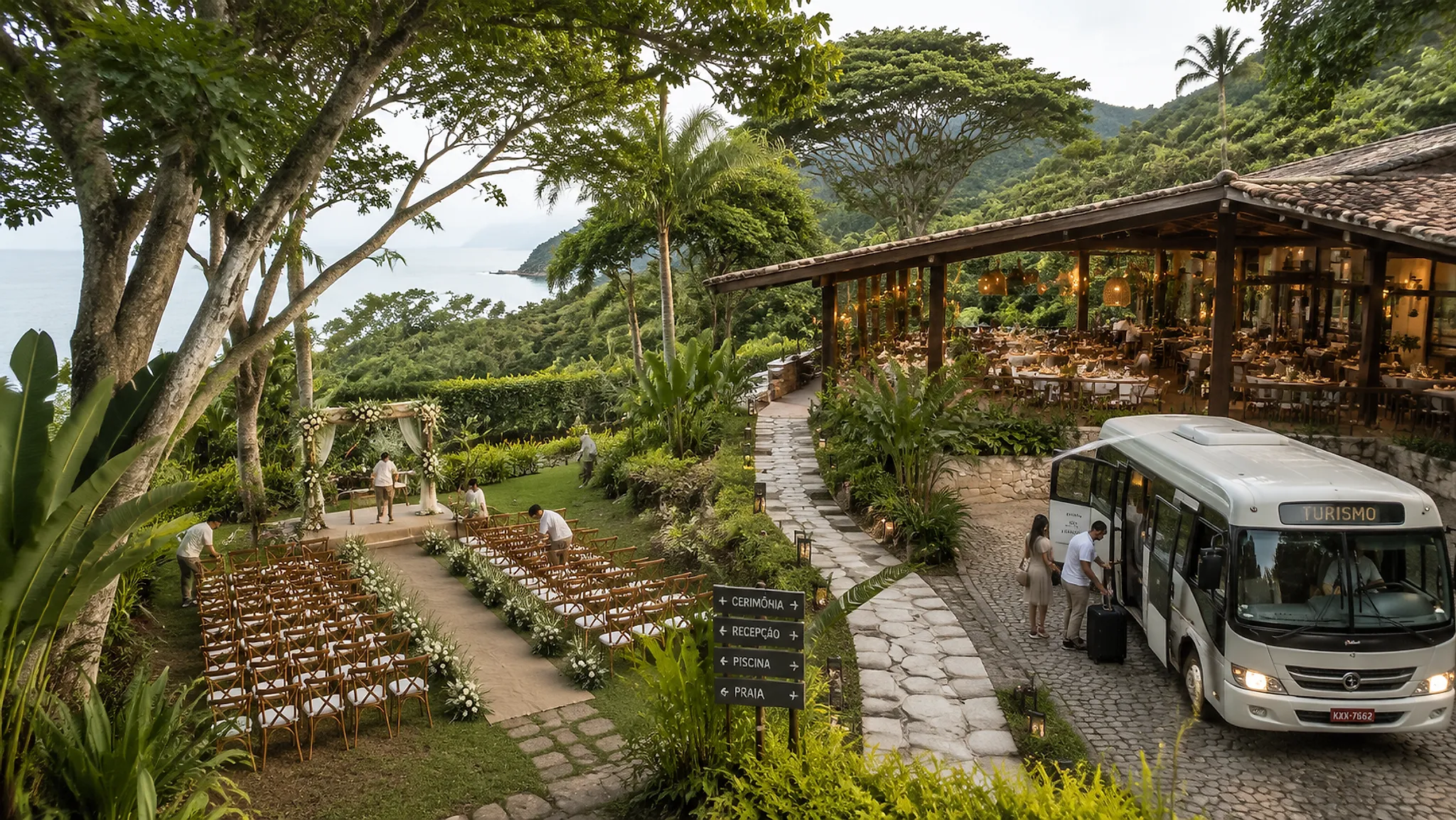
More specific pages
These pages continue the topic in smaller, more specific directions.
Start With a Connected Planning Map
Before comparing venues or announcing a date, separate the wedding into tracks that affect one another.
| Planning track | First question | What depends on the answer |
|---|---|---|
| Location and budget | What setting can support the guest list and event format? | Travel, lodging, venue infrastructure, vendor reach |
| Ceremony model | Is the celebration symbolic, religious, civil, or a combination? | Scheduling, documents, officiant, ceremony site |
| Family participation | Who advises, hosts, translates, or assists locally? | Communication, authority, guest care |
| Venue and reception | Will the entire event happen in one place? | Transfers, accessibility, timing, photography |
| Local vendors | Which services will be sourced in Brazil? | Contracts, payments, setup, language support |
| Guest travel | How will people reach the destination and move during the stay? | Arrival windows, accommodation, transfers |
| Communication | Where will guests find current information? | Itinerary updates, local contacts, route changes |
| Packing and handoffs | Who carries, supplies, receives, and stores important items? | Garment protection, deliveries, replacement plans |
| Contingencies | What changes if weather, transport, or a supplier disrupts the plan? | Decision deadlines, backup spaces, guest updates |
This map helps prevent a common planning error: treating flights and hotels as a separate travel project. Guest arrival times affect the ceremony schedule. The distance between an airport and venue affects transfer costs and arrival buffers. A separate church and reception venue changes transport, photography, parking, and accessibility requirements.
Give every decision an owner
Couples planning from abroad may rely on relatives or trusted contacts in Brazil for venue visits, Portuguese-language communication, and local context. That support is useful only when the role is specific.
Record who:
- Controls and approves the budget
- Communicates with the venue
- Reviews proposals or contracts in Portuguese
- Attends site visits
- Approves substitutions or scope changes
- Receives and stores deliveries
- Dispatches guest transport
- Makes time-sensitive decisions on the wedding day
- Sends updates to guests
“The family in Brazil will handle it” is not an operating plan. Name the person and define the task.
Family members should not automatically become unpaid planners, translators, drivers, or emergency contacts. Someone may be willing to inspect a venue but not manage suppliers all weekend. Another relative may welcome guests but have no authority to approve additional costs. Clear limits protect both the relationship and the event.
Choose the Location by Its Planning Conditions
Rio de Janeiro, Trancoso, Gramado, Petrópolis, Vale do Café, and countryside properties in the São Paulo region may all appear during destination research. These names are starting points, not a ranking. Suitability depends on the guest group, ceremony format, transport network, venue infrastructure, and backup options.
Evaluate each location as an operating environment:
- Which airports are realistic for the guest list?
- How long is the transfer from the airport?
- Are suitable accommodation options close to the venue?
- Can the ceremony and reception happen on the same property?
- If not, how will guests move between them?
- Which vendors serve the area, and what travel or delivery costs apply?
- Is the site workable for older guests and people with mobility needs?
- Are paths, restrooms, parking areas, and transport loading points accessible?
- What covered or indoor space is available?
- Can formalwear, food, decor, music, and production equipment reach the property?
- Who can act locally before the couple arrives?
A remote countryside property may offer privacy while adding long transfers, limited nearby accommodation, and more complicated deliveries. An urban venue may simplify airport and hotel access but introduce parking, loading, traffic, noise, and scheduling constraints. Historic and religious sites may have their own access, decoration, music, photography, and punctuality rules.
Compare venue models
| Venue model | Questions to resolve |
|---|---|
| Urban venue | Are airport access, hotels, parking, loading, traffic, and noise limits manageable? |
| Coastal or beach setting | What protection exists for rain, heat, wind, wet surfaces, and exposed equipment? |
| Mountain or cooler setting | How do road conditions, temperature changes, and evening weather affect guests and attire? |
| Historic or religious site | Which access, scheduling, ceremony, decoration, music, and photography conditions apply? |
| Rural property | How far are hotels, suppliers, transport staging points, and essential local services? |
| Single-site venue | Can the ceremony, transition, meal, dancing, and photography happen without difficult movement? |
| Separate ceremony and reception sites | What route, vehicle capacity, parking, accessibility, and timing buffers are needed? |
Record venue answers alongside guest and vendor information. A visually appealing property without a workable arrival route or prepared wet-weather space is still an unresolved option.
Test the location against the guest group
A destination suitable for a small, mobile group may be difficult for a larger family gathering. Before committing, gather relevant information privately from key guests:
- Likely departure points and flight connections
- Mobility and accessibility needs
- Comfort with long road transfers
- Preferred accommodation types
- Language support needs
- Travel timing concerns
- Plans to extend the trip
- Need for organized local transportation
The couple does not need to arrange every guest's journey, but the chosen destination should have a coherent arrival plan. Once common travel patterns are visible, the team can define supported hotels, transfer windows, pickup points, and late-arrival procedures.
Separate the Ceremony Options
A destination celebration in Brazil may include one or more of the following:
- 1. A symbolic ceremony designed for the couple and guests
- 2. A religious ceremony arranged with a particular church or faith community
- 3. A civil marriage process conducted in Brazil
- 4. Registration in Brazil of a marriage celebrated in another country
These categories should not be merged. The ceremony guests attend may be separate from the civil process. A religious ceremony may involve its own preparation and permissions. Registering a marriage celebrated abroad is a different administrative question from arranging a civil marriage in Brazil.
Symbolic and religious ceremonies
A symbolic ceremony may allow flexibility in the location, schedule, language, readings, vows, and family participation. Even so, the couple should explain the format clearly to close family members, particularly when relatives have different expectations about the meaning of the event.
Decide:
- Who leads the ceremony
- Which languages are used
- Who participates in readings, vows, or family moments
- How long the ceremony lasts
- Where guests go immediately afterward
- How the format changes if the event moves indoors
Commercial wedding content sometimes presents practices such as placing single friends' names inside a dress or giving the groom a prominent entrance as broadly Brazilian traditions. Prevalence and meaning can vary. Treat such ideas as prompts for a family conversation, not as elements every Brazilian wedding should include.
For a religious ceremony, speak directly with the particular church office or ceremony community about preparation, documents, scheduling, language, music, readings, decorations, photography, video, access, and officiant availability. Ask separately how the religious ceremony relates to any civil process relevant to the couple.
Civil processes and foreign-marriage registration
Terms such as cartório, Cartório de Registro Civil das Pessoas Naturais, proclamas, sworn translation, apostille, legalization, witnesses, personal appearance, marital-capacity records, and foreign-marriage registration can help frame an inquiry. They do not create a nationwide checklist.
Ask the selected cartório:
- Which process applies to this couple
- Which documents are requested for that process
- Whether any documents have issue-date or validity conditions
- How translation or authentication is handled
- Whether appointments or personal appearances are involved
- What local lead times and fees apply
- How witnesses or representatives are handled
- Which office receives a later registration request
The Brazilian Ministry of Foreign Affairs publishes marriage-registration information for a marriage celebrated abroad within a particular consular context. It is useful for understanding that foreign-marriage registration is its own process, but it should not be applied as a universal document list for every nationality, consular district, or cartório.
Coordinate Venues, Vendors, and Family From Abroad
Remote coordination needs a shared record that shows the current decision, responsible person, and next action. Long email threads alone make it difficult to identify which proposal is current or whether a payment, delivery, or setup question remains open.
Maintain one working file or project space for:
- Venue proposals and included services
- Vendor roles and contact details
- Contract and payment status
- Currency and payment method
- Setup, delivery, and collection responsibilities
- Portuguese-language communication needs
- Site-visit notes
- Storage arrangements
- Decision deadlines
- Primary and backup contacts
- Outstanding questions
For each supplier, identify who owns the next action. A family contact might translate a message, inspect a room, receive printed materials, or confirm that a delivery arrived. The venue or coordinator should still have documented responsibilities.
Use structured site visits
An in-person visit can reveal conditions that edited photographs do not show: road surfaces, loading access, shade, sound limits, storage, restroom routes, lighting, and the actual distance between ceremony and reception areas.
When no one from the couple's team can visit, request a live remote walkthrough covering:
- Guest arrival, parking, and transport unloading
- Ceremony and reception spaces
- The indoor or covered alternative
- Restrooms and accessibility routes
- Vendor loading and setup areas
- Storage
- Power and lighting locations
- Photography areas
- Paths guests use during the event
- Surfaces and shelter on a wet-weather route
Separate what the team has observed from what the venue has described and what remains to be checked after arrival. This prevents assumptions from quietly becoming planning facts.
Define wedding-day authority
Before the event, decide who handles schedule changes, vendor arrivals, transfer dispatch, missing items, seating or meal changes, payment questions, and the move to a backup space. The couple should also state which decisions can be made without interrupting them.
A local relative may support this structure, but no single family member should be the only person who understands how the event works.
Build the Timeline Around Dependencies
A Brazil destination wedding timeline should reflect the location, ceremony model, guest count, travel distance, and amount of remote planning involved. A generic 12- or 18-month template may offer prompts, but local availability and procedure-specific lead times have to come from the relevant offices and suppliers.
| Planning phase | Main work | Dependency to watch |
|---|---|---|
| Define the event | Guest range, budget, ceremony model, destination conditions, planning roles | Location and ceremony choices shape nearly every later decision |
| Test feasibility | Venue access, accommodation, supplier reach, local inquiries, backup space | A date is only useful when the operating conditions work |
| Connect the plan | Contracts, guest hub, flights, transfers, reception flow, photography, family roles | Separate workstreams need shared timing and ownership |
| Prepare dispatch | Final guest details, room information, transport assignments, vendor windows, handoffs | Another person must be able to act from the instructions |
| Run the event | Arrival checks, setup review, weather decision, guest updates, transport dispatch | Authority and escalation routes must be clear |
Early inquiries should go to the selected venue, cartório, church office, and coordinator where relevant. Some answers may determine whether a date or location remains workable.
As the plan develops, connect the tracks:
- Match accommodation areas to transport routes.
- Match guest arrival windows to hosted events.
- Match ceremony timing to photography and reception movement.
- Match family roles to actual availability.
- Match carried items to storage and handoff arrangements.
- Match the weather decision deadline to vendor setup.
- Match guest updates to the person monitoring travel and transport.
In the final stage, turn information into instructions that someone else can use. Consolidate arrival details collected with guests' knowledge, hotel assignments, event addresses, vendor windows, family roles, transport lists, backup arrangements, packing ownership, and current payment or delivery status.
A useful timeline does more than collect dates. It shows what must happen first, who acts next, and what changes when a dependency moves.
Plan the Guest Journey From Airport to Reception
Flights, accommodation, and ground transportation belong in the event plan because they determine whether guests can reach each part of the wedding comfortably and on time.
Set realistic arrival guidance
Consider the number of flight segments, road-transfer length, venue remoteness, and consequences of a missed connection when suggesting an arrival window. Avoid presenting any buffer as a guarantee.
Guest information should state:
- Preferred arrival period
- Latest practical arrival time for planned transport
- Supported hotel or accommodation areas
- Transfer departure points and times
- Individual booking instructions, where applicable
- Late-arrival procedure
- Travel-day contact
- Where schedule changes will be posted
Room blocks can simplify communication, but they do not guarantee availability or suit every group. Confirm inventory, booking deadlines, cancellation terms, accessibility, and transport staging with the accommodation provider.
Map every group movement
For separate ceremony and reception sites, document:
- Departure and pickup points
- Vehicle assignments and capacity
- Loading, parking, and access conditions
- Expected transfer time and schedule buffer
- Mobility-equipment space
- Photography timing
- Arrival order
- Instructions for late guests
- Return transportation
Apply the same method to airport pickups, hotel departures, optional gatherings, and late-night returns. Guests should not have to solve a complicated local route individually after receiving only an address.
Prepare for flight changes
A limited-access travel list can help the designated contact monitor arrivals and update transfer providers. Collect only information needed for coordination, explain its purpose, and define who can access it.
Passenger options should be checked against current ANAC guidance on flight changes, delays, and cancellations. The available response may depend on the disruption and current rules. Airline assistance or passenger remedies do not preserve the wedding schedule or replace the event's contingency plan.
The couple's operational response should cover:
- Who receives revised flight information
- Who alerts the transfer provider
- Whether a delayed guest travels directly to the venue
- How the itinerary is updated
- What happens when a guest cannot arrive before the ceremony
Design the Guest Experience and Reception Flow
A wedding website or equivalent shared hub should give guests one current source for addresses, schedules, lodging, transportation, attire, and changes.
Include:
- Event addresses and map references
- Airport and accommodation guidance
- Transfer instructions
- Ceremony and reception times
- Dress guidance
- Language information
- Local contact details
- Accessibility notes
- Fixed and optional activities
- Weather or route updates
- A visible “last updated” date
Distinguish hosted events from optional suggestions. Welcome gatherings, outings, farewell meals, and sightseeing can be useful, but they are not a prescribed Brazilian wedding format. Guests may also need time to rest, care for children, manage work, or make their own plans.
Explain terms such as cartório, padrinhos, and madrinhas when they appear in guest-facing information. In a bilingual or diaspora wedding, decide which messages need both English and Portuguese and who can help guests when live translation is needed.
Clarify family and ceremony roles
There is no single family-role structure that fits every Brazilian or Brazilian-diaspora wedding. Ask the couple and relevant relatives:
- Who escorts or enters with whom?
- Who participates in readings, vows, blessings, or other ceremony moments?
- Are padrinhos and madrinhas part of the plan?
- Who welcomes guests or gives speeches?
- Who assists older relatives or guests needing help with the venue?
- Which relatives belong in formal photographs?
- Which traditions are meaningful to this family?
- Which practices are being adapted or omitted?
Responsibilities may be distributed between relatives in Brazil and family members abroad. Make that arrangement explicit instead of treating location, seniority, or family title as automatic authority.

Walk through the reception in sequence
Use a neutral event sequence to test timing:
- 1.Guest arrival and welcome
- 2.Ceremony seating or reception entry
- 3.Cocktail or transition period
- 4.Family and wedding-party photographs
- 5.Meal service
- 6.Speeches and planned formal moments
- 7.Dancing or entertainment
- 8.Departure and return transport
This is a planning tool, not a universal Brazilian reception order. It helps the team identify where guests wait, when suppliers reset spaces, how photography interacts with the meal, and whether transport departures conflict with key moments.
Connect attire and photography to logistics
Separate clothing and accessories into items carried by the couple, transported by someone else, supplied locally, or replaceable after arrival. Consider garment protection, storage, weather exposure, event changes, and the different clothing needed for travel, ceremony, reception, and optional gatherings.
The photography brief should identify:
- Ceremony participants
- Immediate-family and wedding-party groupings
- Cultural or family details
- Priority reception moments
- Venue and guest atmosphere
- Private or restricted photographs
- Accessibility and privacy considerations
- Time and movement between locations
When the ceremony and reception are separate, photography time belongs in the transfer schedule. It should not be treated as time the photographer can simply recover later.
Organize Packing, Deliveries, and On-Site Handoffs
A Brazil wedding packing checklist is more useful when organized by consequence and ownership than by product category. Airline baggage rules, customs treatment, entry conditions, medication rules, and security restrictions should be checked with the relevant current authorities and carriers for each traveler's circumstances.
| Category | Typical contents | Planning treatment |
|---|---|---|
| High-consequence personal items | Passports, applicable travel documents, rings, essential ceremony pieces | Assign to a named person and keep securely accessible |
| Formalwear and accessories | Ceremony clothing, shoes, jewelry, veils, ties | Protect from moisture and crushing; confirm storage after arrival |
| Procedure-related records | Paperwork requested for the couple's specific civil or religious process | Confirm the exact set with the responsible office and store copies securely |
| Locally supplied items | Flowers, food, furniture, standard venue equipment | Confirm inclusion, quantity, delivery, setup, and substitution responsibility |
| Vendor-delivered materials | Rentals, printed materials, decor, ceremony items | Name the recipient, delivery window, storage point, and return owner |
| Replaceable personal items | Toiletries, casual clothing, small accessories | Pack for the destination and event schedule |
| Coordination kit | Contact list, schedule, labels, chargers, basic repair supplies | Assign an owner and keep it available during setup |
For every important item, record who brings it, where it is stored, who checks it after arrival, when it reaches the venue, who returns it, and what fallback exists. Apply the same method to rings, clothing, printed ceremony materials, gifts, decor, and family heirlooms.
Do not assume an item is included because it appears in a venue gallery or inspiration image. Mark it as venue-supplied, rented, vendor-delivered, carried by a guest, or still unresolved.
Schedule a short on-site meeting with the venue and key vendors after arrival. Review the event sequence, setup areas, guest routes, weather status, contact hierarchy, transport arrangements, and decisions that still require the couple's input.
Prepare for Weather and Other Disruptions
Brazil includes very different climates and local conditions. A general destination guide cannot identify a universally preferable month or predict conditions for a future wedding date. Use location-specific seasonal information, current forecasts close to the event, and the venue's operational knowledge.
A February 2026 severe-weather report describes a particular episode of heavy rain, thunderstorms, lightning, and related disruption in parts of Brazil. It illustrates why roads, utilities, outdoor spaces, and guest movement need contingencies. It does not establish normal frequency for a destination or predict another event.
Ask the venue:
- Which covered and indoor areas are available?
- How quickly can the ceremony move?
- What conditions trigger a change?
- Who makes that decision?
- How much notice do suppliers need?
- Are paths, ramps, parking areas, and loading points workable after rain?
- Where can vendors continue setup?
- How are guests sheltered between vehicles and event spaces?
- How do heat, wind, or moisture affect food, flowers, attire, sound, lighting, and photography?
- How will the revised plan be communicated?
Name the decision-maker and deadline. “We will decide if the weather changes” does not tell the venue, photographer, transport team, or guests when to switch plans.
Keep separate responses for separate disruptions:
| Disruption | Immediate planning question |
|---|---|
| Heavy rain, lightning, or wind | Can the event move into a prepared covered space within the setup deadline? |
| Extreme heat | Which timing, shade, ventilation, water access, attire, and guest-comfort arrangements can change? |
| Flight delay | Who updates the transfer provider and revised arrival list? |
| Road disruption | Which route, pickup point, vehicle, or arrival sequence changes? |
| Vendor cancellation | Who can approve a replacement, substitution, or reduced scope? |
| Missing luggage | Which attire or personal items can be sourced locally? |
| Guest assistance need | Who responds, which local contact is used, and how does the schedule adapt? |
| Venue fallback | What must be moved, protected, removed, or communicated? |
A forecast is only one input. Pair it with a prepared alternative space, a decision process, supplier instructions, and a way to reach guests quickly.
Where to plan next
Move into the topic currently blocking progress: location comparison; remote vendor coordination; the dependency timeline; ceremony and local procedure questions; flights and accommodation; ground transportation; guest communication; packing and on-site handoffs; or weather contingencies. Each should extend this planning map rather than operate as an isolated checklist.
The final test is straightforward: can the couple, family, venue, vendors, and guests see what happens next, who owns the decision, and what changes if the original plan no longer works? A strong Brazil destination wedding plan makes room for regional conditions, family-specific traditions, locally confirmed procedures, and the practical work of moving people and important items across a large country.
Sources
Sources and further reading
Reference links are limited to sources considered suitable for public citation in this page.