
Ceremony and Local Procedure Planning
Getting married in Brazil usually involves several connected plans rather than one single event. The Cartorio, a church or cultural ceremony, the festa, consular paperwork, and family expectations may each have different schedules and decision-makers.
Separate those tracks before booking wedding travel or committing to a reception date. The intended Cartorio handles civil-registration questions. A parish or church office handles its own ceremony preparation. A venue controls access, timing, and operational rules. A consulate or embassy may explain a document route for its nationals. Families, attendants, and celebrants help coordinate the social and ceremonial side.

There is no single nationwide checklist that settles every couple's situation. The answer can depend on the selected Cartorio, each person's nationality, the documents available, the ceremony route, and the church or venue involved. Use general information to prepare questions, then request current written instructions from the office or person responsible for each part of the plan.
Civil Registration and the Wedding Celebration Are Different Tracks
A civil marriage at a Cartorio is not automatically the same event as a religious, cultural, or social celebration. A couple may plan a brief civil ceremony, a church ceremony, a cultural ceremony, or a larger festa. The order and relationship between those events can be shaped by local procedure, religious practice, family expectations, and travel schedules.
The distinction matters because each decision may belong to a different person or office:
| Planning question | Who to ask |
|---|---|
| Which Cartorio handles the couple's case? | The intended Cartorio |
| Which documents are accepted and in what form? | The intended Cartorio and, where relevant, the consulate or embassy |
| Whether a foreign document needs translation, apostille, or legalization | The receiving Cartorio and the relevant document authority |
| Whether a church ceremony is available on the chosen date | The parish or church office |
| Whether preparation, readings, music, rehearsal, or ceremony materials are expected | The parish or church office |
| Whether the reception schedule can accommodate the civil or church event | The venue and planner |
| Whether a marriage should later be registered with a consulate | The relevant consulate or embassy |
Research on Brazilian marriage-record terminology also distinguishes the place where a marriage is celebrated, the institution responsible for civil registration, and the place where a certificate is issued. Those points may overlap, but they should not be assumed to be identical in every wedding plan.
Some couples are familiar with a civil-before-religious sequence. Treat it as a planning pattern to discuss with the relevant offices, not as a universal instruction. In Brazilian-diaspora weddings, couples may also adapt the order, scale, or location of each event.
Questions to Ask a Cartorio Before Booking Wedding Travel to Brazil
Before buying non-refundable travel or fixing the reception date, contact the Cartorio you expect to use. A consular planning example for Ireland in Sao Paulo notes that Brazilian Cartorios handle civil marriages and that documentation can differ between offices. The practical point is to ask the intended office about your circumstances before ordering documents or relying on a checklist prepared for another route.
Include the following information in your first message where relevant:
- Both people's nationalities
- Current country of residence
- Whether either person was previously married
- The city or area where you expect to marry
- Whether you intend to hold a civil ceremony, a religious ceremony connected to a civil-registration route, or separate civil and celebratory events
- Your preferred travel and celebration dates
- Any language or accessibility needs
- Whether one or both people will be outside Brazil during part of the preparation
Then ask the questions that affect timing, travel, and document preparation:
- Which Cartorio handles this case? Ask whether the selected office is appropriate for your circumstances or whether another Registro Civil das Pessoas Naturais, sometimes abbreviated as RCPN, should handle the process.
- What is the current document list for each nationality? A list prepared for one foreign nationality may not describe another person's documents. Ask whether the office needs identity documents, birth records, civil-status records, records concerning a prior marriage, or another form of evidence.
- Which documents must be originals? Some consular routes specify original documents, issue dates, certificate formats, or physical presentation. Use those details to form questions for the Cartorio rather than treating one route as a general rule.
- How recent must civil-status certificates be? Ask whether an issue-date limit applies and whether it covers every document or only particular records. Confirm what would happen if the ceremony date changes.
- Is a sworn Portuguese translation required? Ask whether the translation must be completed by a tradutor juramentado and whether the Cartorio has requirements for format, signatures, or accompanying documents. The receiving office should confirm what it accepts.
- Is an apostille or legalization needed? Document treatment may depend on the issuing country, document type, and route. Ask which authority handles the step and whether translation occurs before or after it.
- Does the relevant nationality use a Certificate of No Impediment or Certificate of Freedom to Marry? These expressions appear in international marriage-planning material, but the document name, issuing authority, format, and receiving office may differ. Ask both the Cartorio and the person's consulate or embassy to identify the applicable route.
- When must documents be submitted? Ask whether the office accepts documents by appointment, in person, through a representative, or by another process. Confirm whether the couple must be present at filing, at the ceremony, or at both stages.
- Are witnesses involved, and at which stage? Ask separately about filing, the civil ceremony, document declarations, or another appointment. A practice described by one office should not be generalized to every case.
- Can a representative handle any step? If travel is difficult, ask whether a representative or procurador can submit documents or attend a particular appointment. Confirm the authorization format and any limits on representation.
- Is language support available? Ask whether the Cartorio provides interpretation, permits an interpreter chosen by the couple, or expects another arrangement. Do this before the appointment rather than assuming a bilingual family member will be accepted.
- When and in what format is the marriage certificate issued? Ask whether it is issued on the ceremony date, later, or after another administrative step. Confirm whether the available format will meet any separate consular, translation, travel, or record-keeping need.
Questions about marital property arrangements, a pacto antenupcial, later recognition abroad, immigration, residency, or citizenship belong with the relevant Cartorio, consulate, or qualified local professional. They are related planning concerns, but they are separate from choosing the ceremony schedule.

How to Judge Brazilian Cartorio Marriage Requirements
The phrase “Brazilian Cartorio marriage requirements” can make the process sound like a fixed national package. A more useful approach is to judge each checklist by its scope and identify what still needs confirmation from the selected office.
- Who issued it? A government or consular source may explain a particular route. A law firm or translation provider may be describing a service process or offering question prompts.
- Which nationality does it address? A process for one country's citizens may not describe another person's documents.
- Which city or Cartorio does it cover? One local experience does not establish another office's practice.
- When was it prepared? Office instructions and procedures can change.
- Does it distinguish civil registration from ceremony planning? A church checklist, venue list, or immigration guide cannot answer every Cartorio question.
- Does it identify exceptions and decision-makers? Useful material should make clear what remains to be checked and by whom.
Terms such as habilitacao, proclamas, certidoes, and RCPN can help couples communicate with offices and translators. Historical registry material can also explain why some terms appear in records. Neither vocabulary nor historical context establishes the current instructions of a particular Cartorio.
Foreign Documents, Translation, and Certificate Planning
Couples marrying across borders may need to coordinate several document routes before traveling. Consular and embassy material can help identify questions about originals, certificate issue dates, document format, physical presentation, translation, and authentication. It does not create one document list for every couple.
Build a question sheet with one row for each document:
| Document question | Who should confirm it |
|---|---|
| What is the exact name of the document? | Cartorio, consulate, or issuing authority |
| Must it be an original or a certified copy? | Receiving Cartorio |
| How recent must it be? | Receiving Cartorio |
| Does it need an apostille or legalization? | Cartorio and relevant authority |
| Does it need a sworn Portuguese translation? | Cartorio and translator |
| Must the translation be attached to the original? | Receiving Cartorio |
| Must the person present it in person? | Cartorio or consulate |
| Will a representative be accepted? | Cartorio, including authorization details |
| Will the issued certificate need another format or translation later? | Cartorio and the separate receiving institution |
A general explanation of apostilles, legalization, or translation can clarify vocabulary, but the document type and destination route still matter. Ask the receiving office before ordering a step that may not match its instructions.
The same caution applies to names, previous marriages, property arrangements, and certificate recognition. These subjects often appear in commercial planning material because readers search for them, but they may involve separate legal or consular questions. Keep them on the referral list instead of treating them as settled by a general wedding article.
Coordinate a Church or Cultural Ceremony Separately
A church ceremony may be central to the couple and their families, but church planning is not a substitute for Cartorio confirmation. Catholic ceremony-planning language commonly includes parish coordination, preparation before marriage, documents, readings, music, decorations, rehearsal, and ceremony materials. The parish or diocesan office determines what applies to its ceremony.
Ask the church office:
- Is the desired date available?
- Which couple must attend the first meeting?
- Is a premarital preparation process part of the parish's planning?
- Which documents should the couple ask about?
- Are baptism, confirmation, freedom-to-marry, or other records relevant to this parish?
- How are readings selected?
- Who coordinates music?
- Are decorations subject to church rules?
- Is a rehearsal scheduled?
- Which attendants or witnesses have a role in the ceremony?
- Are ceremony materials supplied by the parish or prepared by the couple?
- Can preparation completed in another country be discussed with the parish?
- How does the parish describe the relationship between the church ceremony and civil registration?
A generic church guide may provide useful vocabulary for these questions, but it cannot establish Brazilian parish requirements. Religious preparation, civil registration, and the festa work better as connected projects with different owners.
For a cultural ceremony, ask the celebrant and family contact about language, order, symbolic elements, participation, music, and documentation. If the event is intended to carry separate legal or religious significance, confirm that point with the institution responsible for it rather than relying on the ceremony's title.
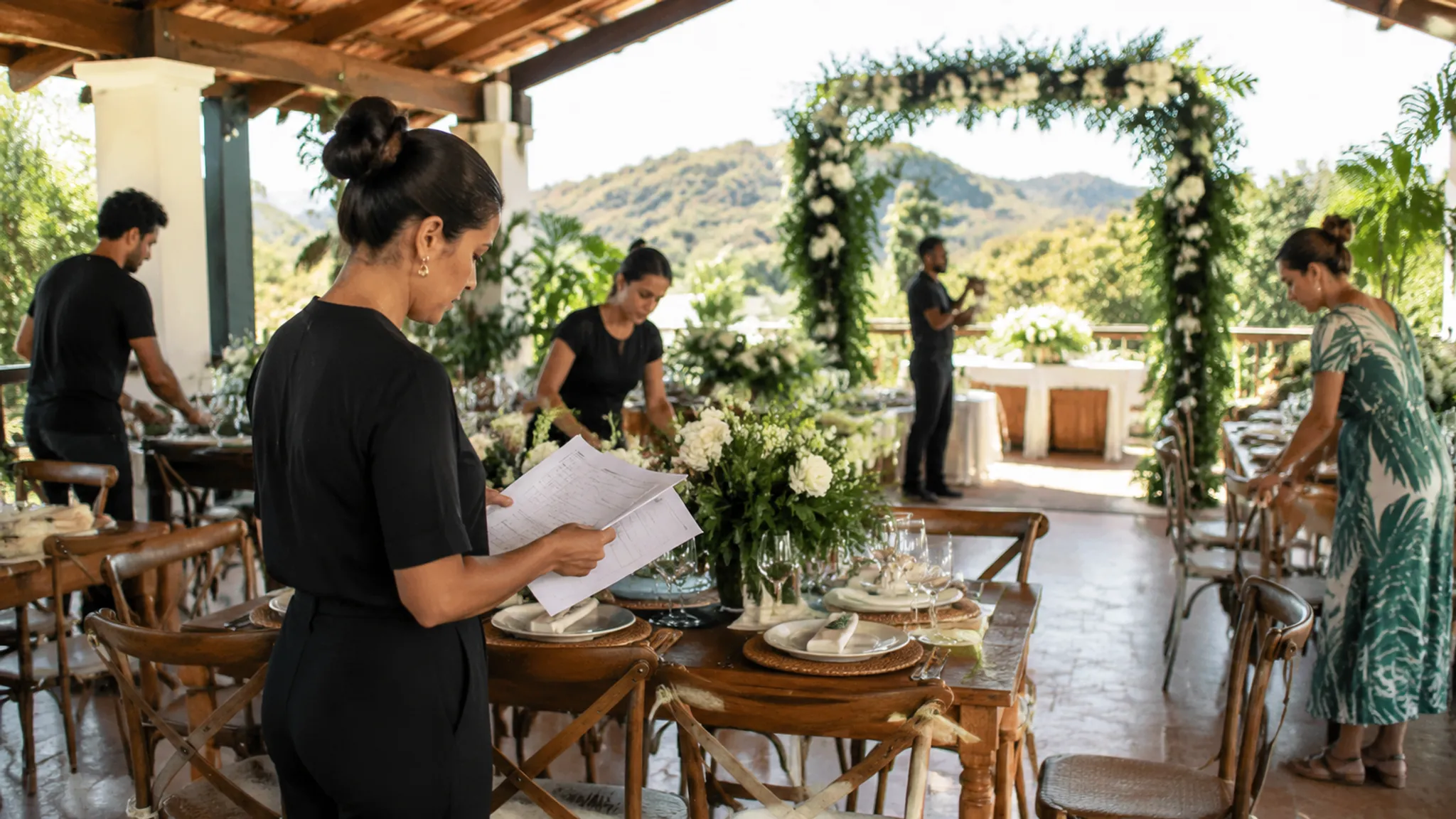
Protect the Festa Schedule From Administrative Uncertainty
The festa may include an entrance, speeches, food, music, dancing, family photographs, sweets, and other traditions. These are social planning decisions, but they can still be affected by the timing of the Cartorio or church ceremony.
Keep one working schedule with separate milestones:
- Initial Cartorio contact
- Written document instructions
- Translation or authentication questions
- Appointment or filing confirmation
- Civil ceremony date
- Church or cultural ceremony date
- Certificate issuance question
- Venue access and reception schedule
- Family and attendant arrival plans
- Consular or other separate document questions
A low-weight user report described a process taking approximately six weeks to two months. That is not a national timeline or a dependable estimate for another couple. It is useful only as a prompt to ask about filing, ceremony scheduling, and certificate issuance early enough to protect the travel itinerary.
Avoid placing the civil appointment immediately beside a major reception commitment until the Cartorio has explained its sequence and timing. Ask the venue how changes could affect access, supplier arrival, ceremony space, photography, and guest movement. Family members traveling from elsewhere may also need a schedule that separates administrative appointments from celebration days.
Common Mix-Ups to Resolve Early
“The church ceremony is the civil marriage”
A church, cultural, or social celebration may be separate from civil registration. Ask the Cartorio and church office how each institution describes the proposed route.
“A checklist online applies everywhere”
A law-firm page, translation-provider page, expat post, or social-media discussion may reveal useful search terms such as Certificate of No Impediment, tradutor juramentado, proclamas, or pacto antenupcial. It does not establish what every Cartorio requests.
“The consulate can answer the Cartorio's questions”
A consulate or embassy may explain its own document services or a route for its nationals. The Cartorio remains the place to confirm what it will accept for the civil-registration process.
“Marriage paperwork also settles immigration”
Marriage, consular registration, immigration, residency, and citizenship are separate tracks. Keep travel or immigration questions with the relevant consulate or qualified local professional.
“The same family roles apply to every ceremony”
Padrinhos and madrinhas may have an important social, religious, or ceremonial role, but responsibilities depend on the ceremony and the families involved. Ask who must attend each appointment and who is participating only in the celebration.
A Practical Decision Path for Couples
If the couple has not chosen a Cartorio: Identify the city, the circumstances relevant to the case, and the intended ceremony route. Then ask which office handles the matter.
If the couple has a Cartorio but no document list: Send both nationalities, residence details, relevant prior-marriage information, and intended dates. Request a written list and ask about originals, issue dates, translation, apostille or legalization, witnesses, representatives, language support, and certificate timing.
If the couple has a civil plan but no church plan: Contact the parish separately. Ask about availability, preparation, documents, ceremony elements, rehearsal, and expectations for attendants.
If the couple has booked a venue before confirming procedure: Protect the date with a written schedule that identifies unresolved points. Ask the venue about change windows and administrative-day logistics.
If the couple is planning from outside Brazil: Separate tasks that require physical presentation from tasks that may be handled through a representative or remote communication. Confirm each assumption with the Cartorio, consulate, translator, church office, or other responsible person.
If family members expect a particular sequence: Write down the civil, religious, cultural, and reception events separately. Discuss which parts are customary in the family, which are requested by an institution, and which are simply the couple's preferred arrangement.
The Questions Worth Carrying Forward
- Which Cartorio is handling the civil-registration route?
- Has that office reviewed the couple's nationalities and circumstances?
- Which documents must be original, recent, translated, apostilled, legalized, or physically presented?
- Does the relevant nationality use a Certificate of No Impediment or Certificate of Freedom to Marry?
- Are witnesses involved, and at which stage?
- Can a representative handle any part of the process?
- Is language support available?
- When is the marriage certificate issued, and in what format?
- Which questions belong to the consulate rather than the Cartorio?
- Which church or cultural decisions belong to the parish, celebrant, or family?
- Can the venue schedule absorb changes if an administrative date moves?
- Have civil, church, reception, and family schedules been placed on one shared calendar?
The strongest middle-level plan is not the one with the longest checklist. It is the one that shows which event is being planned, which office controls the next decision, which documents still need confirmation, and how much flexibility the travel and reception schedule can retain.
For couples getting married in Brazil, clarity comes from keeping civil registration, ceremony, celebration, and cross-border paperwork connected but distinct. That structure makes local variation visible and turns uncertain procedure into questions for the people responsible for answering them.
Sources
- Conselho Nacional de Justiça - Registro Civil das Pessoas Naturais
- Portal Consular - Ministério das Relações Exteriores
- Conferência Nacional dos Bispos do Brasil
- Marriage Registration — Ministério das Relações Exteriores
- Marriage And Civil Partnership | Ireland's Consulate in São Paulo | Ireland.ie
- Terms designating places for the celebration and civil registration of marriages and places for the issuances of marriage certificates in Brazilian history