
Ground Transportation and Guest Movement
For a Brazilian or Brazilian-diaspora destination wedding, transportation is not one ride. It is a chain of separate movements: airport to accommodation, accommodation to the ceremony, ceremony to the reception, reception back to accommodation, and, on another day, accommodation to the airport.
The useful planning question is not simply whether to book a wedding shuttle. It is: which guests need to move, between which points, at what time, with what luggage or mobility needs, and who will communicate when the plan changes?
A plan that works for the ceremony can still leave arriving guests waiting at an airport, guests with luggage without a practical transfer, or older relatives unsure where to meet the vehicle after the reception. The available material supports a careful planning structure, but it does not establish one universal Brazilian wedding-transport practice or a standard for every private shuttle.
Start by Mapping Every Guest Movement
Before comparing vehicles or requesting quotations, draw the route as separate legs. A wedding transportation map may include:
- Airport to hotel, villa, or other accommodation
- Accommodation to ceremony site
- Ceremony site to reception venue
- Reception venue to accommodation
- Accommodation to airport for return departures
- Optional movements for a rehearsal, welcome event, civil appointment, church meeting, or family gathering
Each leg has different conditions. Airport arrivals are shaped by flight times, baggage collection, and possible delays. The hotel-to-ceremony shuttle depends on guest readiness and the venue's arrival window. The ceremony-to-reception transfer may need to account for photographs, family greetings, or a change of location. Late-night returns depend on when guests actually leave and whether one departure time is realistic.
Destination-wedding research places accommodation, local services, transport, and guest logistics within the same destination experience. That is a useful planning lens: transportation is part of the guest plan, not an isolated supplier line. It still does not confirm a particular schedule, route, price, or local custom.

Airport Arrivals and Event Shuttles Are Different Decisions
A hotel airport shuttle does not automatically solve transportation between the hotel and the wedding venue. A vehicle arranged for the ceremony may also be unavailable for individual airport arrivals.
Separate the arrival plan from the event-day plan when guests arrive at different times. Possible arrangements include:
- A transfer window for guests whose flights arrive close together
- Individual or small-group airport pickups
- A designated meeting point that accounts for baggage collection and airport layout
- A hotel-based gathering point for the following day's wedding shuttle
- Rental cars or independently arranged transfers for guests outside the main arrival window
- A local contact who can explain the next step if a guest misses the planned pickup
These are planning options rather than universal recommendations. The appropriate choice depends on guest numbers, accommodation layout, airport conditions, flight patterns, luggage, budget, and the provider's actual terms.
ANAC information can help separate airline and airport matters from a privately booked ground service. Airline procedures may address changes, delays, cancellations, baggage, or passenger assistance. They do not by themselves determine whether a wedding shuttle waits, changes its route, refunds a missed ride, or provides another vehicle. Those questions belong in the ground-transport agreement and should be confirmed with the provider.
Collect flight information early enough to see whether arrivals form workable groups. Keep it current, but avoid assuming that every delay can be absorbed by the same vehicle. A small change in one arrival may affect the next pickup wave.
Build a Wedding Shuttle Pickup Plan in Brazil
A practical wedding shuttle pickup plan should answer four questions for every group:
- Who is being collected? Guests may be grouped by hotel, flight window, family connection, mobility needs, or event role.
- Where do they gather? Name the hotel entrance, airport meeting area, venue loading point, or another location confirmed by the responsible property.
- When does the vehicle depart? Give a departure time and distinguish it from the time guests should be ready.
- Who handles questions? Assign one contact for the transportation plan rather than asking guests to search through several supplier messages.
For a Brazil destination wedding, use location-specific information supplied by the actual airport, hotel, venue, or coordinator. “Meet outside arrivals” may be too vague if an airport has several exits or if stopping and loading are controlled. Confirm whether the vehicle can wait, where it may load, and how guests will identify the meeting point.
A pickup message can stay short and practical:
Hotel: [confirmed property]
Ready time: [time]
Departure: [time]
Meeting point: [specific location confirmed by the hotel or venue]
Contact: [named person and current contact method]
If you miss this departure: [confirmed next step]
Complete the placeholders from the actual itinerary. Generic pickup instructions should not be copied into every guest message without checking whether the location and access arrangements are still correct.

When Staggered Pickup Waves Make Sense
One departure is not necessarily sufficient for a group with different schedules. Staggered wedding pickup waves may help when:
- Guests are staying at more than one accommodation
- The ceremony and reception have different arrival requirements
- Some guests need additional time to board or settle in
- Some guests are attending only one part of the celebration
- A venue has a limited or controlled loading area
- The return journey will happen over several hours rather than at one fixed time
- Guests arrive from different flights or leave on different days
A wave system might use an early group, a main group, and a later group. It could also involve a loop between selected accommodations and the venue. The workable arrangement depends on route length, vehicle availability, confirmed loading conditions, and the provider's waiting and turnaround terms.
Staggered waves are a coordination structure, not proof that a transport plan is more reliable or more suitable. Ask who monitors each wave, what happens if a group is late, and whether the same vehicle is expected to complete another leg immediately afterward.
Connecting the Hotel, Ceremony, and Reception
A hotel-to-ceremony shuttle and a ceremony-to-reception shuttle should be planned as distinct movements, even when the same vehicle is intended to serve both.
For the ceremony leg, check:
- Whether guests are expected to arrive together or within a broader window
- Whether the venue or church has a confirmed drop-off location
- Whether the vehicle can wait nearby or must leave after unloading
- Whether family members, padrinhos, and madrinhas have separate timing needs
- Whether guests will carry bags, wraps, gifts, mobility equipment, or other items
For the ceremony-to-reception leg, clarify whether guests leave immediately or after photographs and other activities. If the reception is at another property, communicate the transfer before the ceremony begins. A guest who does not know whether to board immediately, remain for photographs, or wait for a later wave may miss the intended movement even when the vehicle arrives on time.
A church stop is an itinerary possibility, not evidence of a religious requirement or permission. Ask the church office about its own timing and access arrangements, and ask the venue about its loading and arrival rules. Keep those decisions separate from cultural descriptions of family roles or ceremony patterns.
Plan Luggage for Destination-Wedding Guests
Luggage is easy to overlook on arrival day. A guest may have a suitcase, garment bag, formalwear, gifts, or equipment needed for the celebration. Vehicle capacity should therefore be discussed in terms of both people and belongings.
Ask the actual provider:
- How is passenger capacity defined for the proposed vehicle?
- What luggage assumptions are included in the quotation?
- Where will larger bags be stored during boarding and travel?
- Can garment bags, folded mobility equipment, child equipment, or other special items be accommodated?
- Who loads and unloads luggage, and at which locations?
- What happens if the expected luggage volume is higher than reported?
Do not infer capacity from a vehicle's appearance or from a broad category such as “van” or “coach.” Confirm the specific vehicle, passenger arrangement, luggage arrangement, and any substitution terms. There is no independent Brazil-specific standard in the available material for wedding-shuttle capacity or luggage handling.
It may be enough to ask guests for a simple luggage indication rather than collecting unnecessary personal detail. Consider separating the airport transfer from the event-day shuttle when large luggage would make a short ceremony movement impractical.

Plan Mobility Needs as a Separate Conversation
A guest's mobility need should be discussed early and respectfully, rather than treated as an afterthought or covered by a general promise that any vehicle can accommodate every arrangement. Ask what assistance is needed, then confirm each part with the relevant party.
The questions may involve:
- The airport's passenger-assistance process
- The hotel's entrance and boarding area
- The vehicle's step, door, seat, and storage arrangement
- The venue's path from drop-off to the ceremony or reception space
- Boarding time and whether the group schedule allows it
- The need for a companion, equipment, or a specific transfer arrangement
ANAC aviation-accessibility information supports planning questions around air travel. It does not define the practical capacity of a private wedding vehicle, hotel, church, or reception venue. Confirm the airport portion with the airline or airport and the ground portion with the provider and property involved.
Research on event access can explain why route conditions and barriers deserve attention, but a study of another city or event cannot establish conditions at a particular wedding location. Ask the venue to identify the actual entrance and loading path instead of assuming that the main guest entrance is the vehicle drop-off point.
Delay Communication and Missed-Departure Instructions
Flight movement can change the arrival plan. So can baggage delays, weather, traffic, venue transitions, or a guest who cannot find the meeting point. A workable plan gives guests a clear response rather than relying on last-minute group messages.
Decide in advance:
- Who receives updated flight information
- Who contacts the provider when an arrival changes
- Whether the vehicle waits, leaves, or moves to another wave
- How a guest learns that the original pickup has changed
- Whether a missed departure leads to a later shuttle, a new booking, or another arrangement
- Which costs, if any, are governed by the private contract
Keep airline assistance and wedding transportation in separate columns in the planning document. Airline delay or baggage procedures may affect a guest's arrival, but they do not automatically amend the shuttle contract.
Use one current guest information channel and keep the final instructions consistent across the wedding website, welcome materials, hotel desk guidance, and direct messages. If the plan relies on a local coordinator or family contact, confirm that person's availability during the relevant arrival and departure periods.
Late-Night Wedding Return Shuttles
The return journey deserves as much attention as the trip to the reception. Guests may leave at different times, and the couple, wedding party, older relatives, families with children, and overnight guests may not share the same departure preference.
Compare options such as:
- One scheduled return departure
- Two or more return departures at different times
- A repeating shuttle loop, if the route and provider support it
- Separate arrangements for the couple or wedding party
- A clearly identified alternative for guests who leave outside the published windows
Confirm the last departure, waiting terms, pickup location, and contact method. Do not describe a route as automatically available or obligated to wait. If guests may travel after dark or along unfamiliar roads, make the departure information especially clear and ask the venue and provider about the actual loading and route conditions.
Late-night transport may also affect the reception timeline. If a final shuttle leaves before the event is expected to end, tell guests plainly. If no late departure is planned, do not imply that one will be arranged informally at the venue.
Who Owns Each Part of the Plan?
A transportation schedule works better when responsibility is visible.
| Planning question | Person or organization to confirm with |
|---|---|
| Flight status, baggage, or air assistance | Airline or airport |
| Hotel meeting point and loading access | Hotel |
| Ceremony arrival and church access | Church office or ceremony contact |
| Reception drop-off and late-night loading | Venue |
| Vehicle, capacity, luggage, waiting, and backup terms | Ground provider |
| Guest list, roles, and family-specific expectations | Couple, family, or coordinator |
| Updates and missed-departure messages | Named transportation contact |
The couple or family may coordinate the overall plan, but that does not make them the authority on airline procedures, venue access, church-office decisions, or private contract terms. Keeping these roles distinct helps prevent a general wedding schedule from being mistaken for a confirmed operational arrangement.
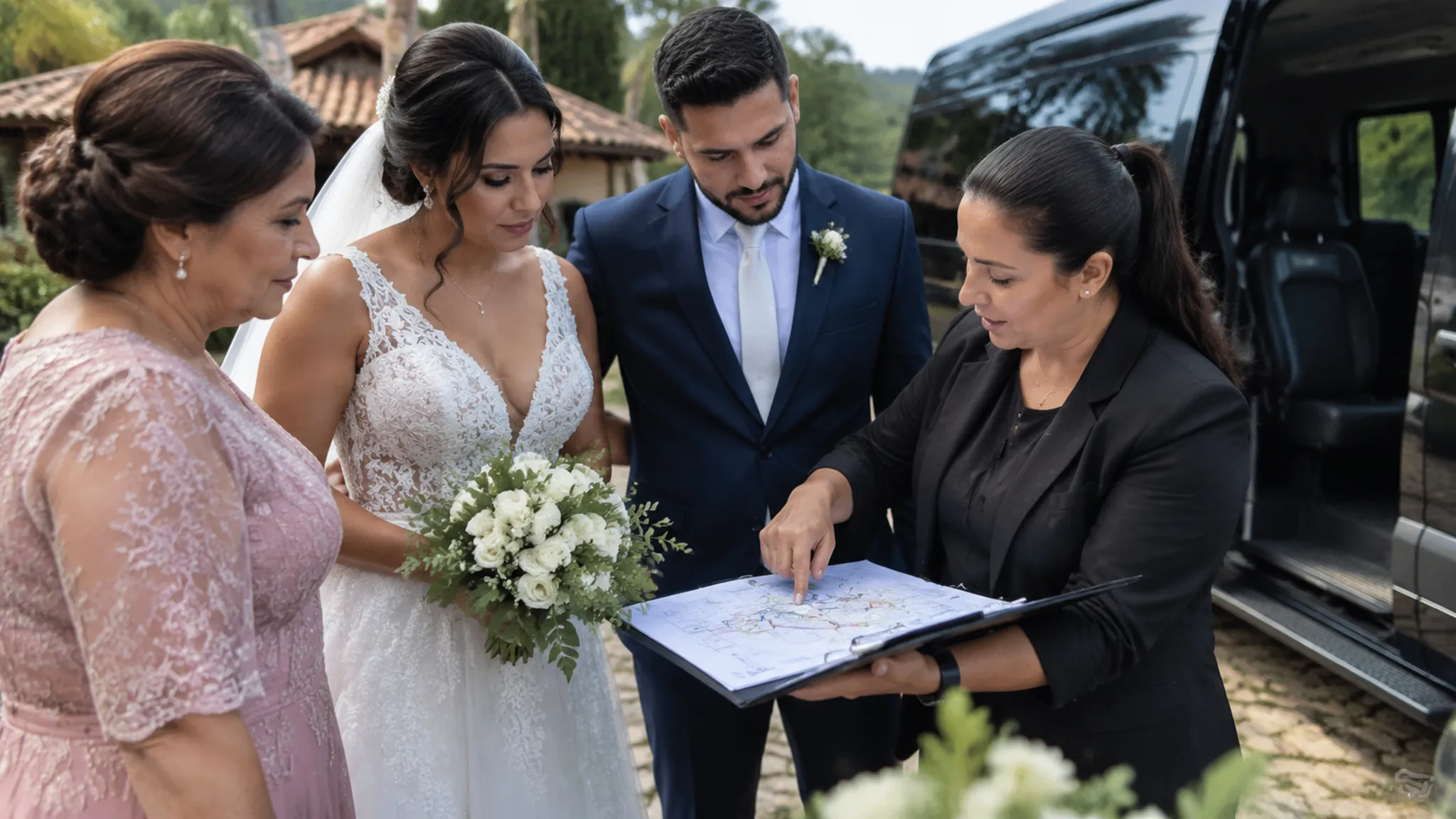
Questions to Confirm Before Choosing a Provider
Use these questions as a comparison tool, not as a checklist that guarantees a result:
- Which vehicle is proposed for each leg?
- What passenger and luggage capacity is included?
- Are pickup points confirmed by the hotel, airport, church, and venue where relevant?
- How much buffer is included between legs?
- What are the waiting-time terms?
- What happens after a delayed flight or baggage issue?
- What is the missed-departure procedure?
- Is a backup vehicle or contact identified, and under what terms?
- How are tolls, route changes, parking, and longer-distance assumptions handled?
- Are separate return departures possible?
- How are mobility needs discussed and confirmed?
- Who sends real-time updates to guests?
- What happens if the vehicle, route, venue access, or schedule changes?
Where appropriate, put the provider's answers into the agreement or itinerary. Words such as “flexible,” “seamless,” or “VIP” are starting points for questions, not independent proof of capacity, punctuality, accessibility, or performance.
A Practical Decision Point for Brazilian and Diaspora Weddings
A simple plan may be enough when most guests arrive together, stay at one accommodation, and travel to one ceremony-and-reception location. More coordination is likely when guests are spread across hotels, flights, venues, family groups, or departure days.
Choose the structure only after checking:
- Number and location of accommodations
- Arrival and departure windows
- Ceremony and reception distance or separation
- Luggage volume
- Mobility and assistance needs
- Venue and hotel loading conditions
- Late-night departure preferences
- Provider waiting, backup, toll, and change terms
- The person responsible for guest communication
In a Brazilian-diaspora wedding, the same plan may need to serve guests familiar with local routes and guests who are not. Write meeting points, times, and alternatives in language everyone can follow. Family expectations may also differ: some guests may expect shared movement, while others may prefer an independent arrival or return. Treat those differences as planning inputs rather than assuming one arrangement represents Brazilian custom.
Final Planning Frame
Ground transportation is best judged as a connected guest-movement system, not as a single booking. Map each leg, separate airport arrivals from event shuttles, decide whether waves or multiple returns are needed, and assign a person to communicate changes.
Then confirm the details that public sources cannot settle: vehicle capacity, luggage handling, loading areas, mobility arrangements, buffers, waiting, backups, tolls, late-night returns, and missed-departure procedures. Check airline and airport matters with the relevant aviation party; check hotel, church, and venue matters with those properties or offices; and check service terms with the actual provider.
That approach gives couples and families a realistic destination wedding transportation plan while leaving local, contractual, and property-specific decisions with the people who control them.
Sources
- National Land Transport Agency (ANTT) - Passengers
- National Civil Aviation Agency (ANAC) - Passengers
- Baggage - Agência Nacional de Aviação Civil (ANAC)
- Flight change, delay and cancellation - Agência Nacional de Aviação Civil (ANAC)
- before your flight - Portal Gov.br
- RESOLUTION No. 280 OF JULY 11, 2013. (Compiled text)
- Destination wedding e suas motivações: uma revisão sistemática da bibliografia