
Brazilian Wedding Family Photo List and Grouping Plan
A useful Brazilian wedding family photo list starts with named people, not a fixed “bride’s side” and “groom’s side” formula. Build it around the couple’s relationships, ceremony context, family priorities, and the time available for portraits.
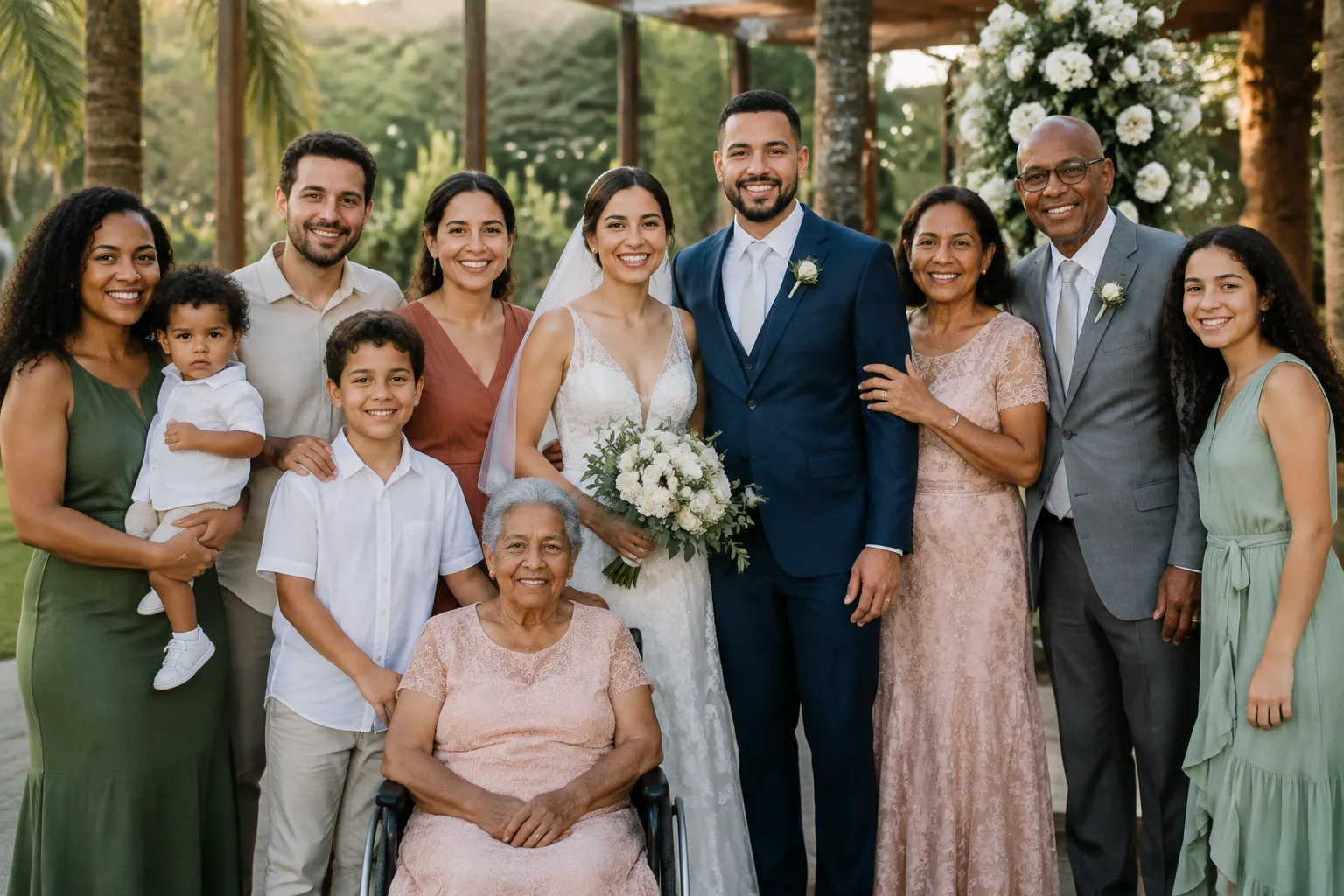
Parents, siblings, grandparents, godparents, chosen family, padrinhos, madrinhas, children, caregivers, and close family friends may all belong on the list. The final grouping order is family-specific. No single national template establishes who belongs together or how long every wedding needs for portraits.
Start With a Wedding Family Relationship Key
Before choosing combinations, create a simple relationship key for the couple and photographer. Use a paper list, spreadsheet, shared document, diagram, or another format everyone can access.
- Full name and preferred name
- Relationship to one or both partners
- Pronunciation or identification notes
- Whether the person attends the ceremony, reception, or both
- Mobility, seating, hearing, vision, or caregiving considerations
- Privacy preferences and family sensitivities
- People who should not be photographed together
- Groups that are essential, meaningful, or optional to the couple
Labels such as “parent,” “sibling,” and “grandparent” may not describe every important relationship. A step-parent, godparent, aunt, uncle, family friend, caregiver, or chosen family member may have a more central place in the couple’s life.
Brazilian research on wedding and family photographs treats these images as part of shared memory and family narrative. That context does not prescribe a current portrait list, but it supports starting with names and relationships rather than a generic template.
Core Brazilian Wedding Family Photo List
Use this as a planning framework, then remove or add groups according to the couple’s priorities.
Couple With Both Sets of Parents
- The couple with both partners’ parents
- Each partner with their own parents
- One partner with the other partner’s parents
- The couple with parents and step-parents
- The couple with parents, children, or siblings
Do not assume that every parent belongs in one group. In blended families, separate portraits may be more comfortable and more meaningful.
Couple With Siblings and Their Partners
- The couple with all siblings
- The couple with siblings and their partners
- Each partner with their own siblings
- Siblings with their parents
- Siblings with their children
- A group including step-siblings or close family members
Ask whether partners should appear in every sibling grouping or only in selected photographs.
Three-Generation Wedding Group
A three-generation wedding group may include the couple, parents, grandparents, and children. Divide it into smaller combinations when the full group is difficult to assemble or standing for long periods is uncomfortable.
Older relatives are often easier to photograph early, while they are available, seated, and comfortable. The photographer and family helper can set the practical order after checking the venue, ceremony schedule, and movement requirements.
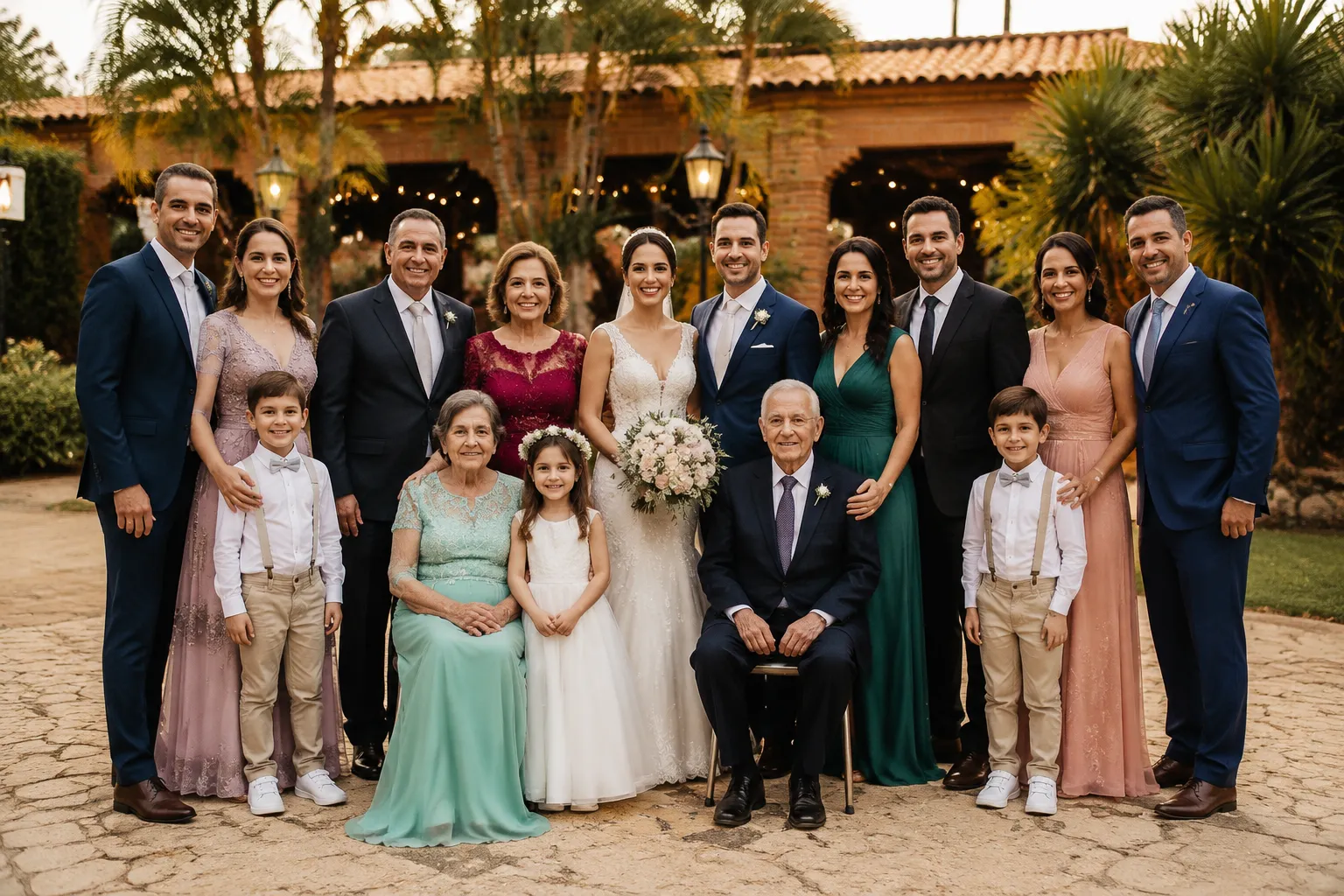
Couple With Each Family
Separate portraits with each family can help when the two family networks have different sizes or structures. Consider:
- The couple with one partner’s immediate family
- The couple with the other partner’s immediate family
- The couple with extended relatives from each side
- The couple with both families together
- Each partner with their own family without the other partner
Define “each family” with the couple. It may mean relatives by birth, relatives by marriage, a household, a chosen family network, or people connected through care and long-term support.
Family-Only Wedding Portraits
A family-only wedding portrait excludes the couple and focuses on relatives or chosen family members. Examples include parents and siblings, grandparents and grandchildren, siblings with their children, a parent with adult children, a household group, or relatives who traveled together.
These photographs are optional. Include them when the family considers them meaningful, rather than because a standard checklist labels them essential.
How to Include Madrinhas and Padrinhos
Madrinha and padrinho are useful planning terms, but they do not automatically map onto a North American maid-of-honor, best-man, bridesmaid, or groomsman structure.
They may be friends, relatives, or other close people selected by the couple. They may be paired without being romantic partners, and matching attire should not be assumed.
Ask which combinations reflect the couple’s relationships:
- The couple with all madrinhas and padrinhos
- Each madrinha or padrinho with the couple
- Madrinhas together
- Padrinhos together
- Each person with their own family
- Madrinhas and padrinhos with parents
- Individual portraits
- Selected family-and-wedding-party combinations
A madrinha or padrinho may also have helped with preparation or family coordination. A locally bounded study of a rural wedding in Minas Gerais describes one madrinha’s involvement with clothing, hair, makeup, and transport. That is a specific community example, not evidence of a universal duty or portrait.
Ceremony-Specific Groupings
The ceremony plan should influence the list. A groom-with-mother portrait or groom-with-close-female-relative portrait may be appropriate when that relationship reflects the entrance or another meaningful part of the day.
- Groom with his mother before the ceremony
- Groom with another close relative involved in the entrance
- Bride with parents or caregivers
- The couple with ceremony participants
- The couple with padrinhos and madrinhas after the ceremony
- The couple with relatives who attended a civil registry appointment
- The couple with family members who could not attend the larger reception
These are prompts, not assumptions. Confirm their order and meaning with the couple. For civil-process questions, ask the local cartorio. For church procedures or photography restrictions, ask the church office.
Choose the Grouping Order
A large-to-small sequence is one common photographer workflow:
- Begin with the largest planned family group.
- Release relatives who need to sit, travel, eat, care for children, or leave early.
- Photograph both-family and extended-family combinations.
- Move to immediate-family groups.
- Finish with smaller combinations and individual relatives.
This order can reduce repeated assembly, but it is not a Brazilian cultural rule. Shade, heat, changing light, venue access, ceremony restrictions, or the location of older relatives may justify another sequence.
When time is limited, remove near-duplicate combinations before removing a group with clear personal importance. A smaller photograph with a beloved grandparent or chosen family member may matter more than several similar large groups.
Plan the Wedding Family Photo Timeline
Timing depends on group size, attendance, punctuality, mobility, venue layout, travel between locations, lighting, weather, and whether everyone is already nearby.
Photographers sometimes use rough planning ranges, such as a few minutes for a small group and longer intervals for larger or less-organized groups. A family list with ten to twelve groups may take around twenty to thirty minutes in favorable conditions, but these figures are working estimates, not promises.
Portraits may happen before the ceremony, after the ceremony, or during the reception. The suitable option depends on the couple’s preference, ceremony format, church or cartorio arrangements, venue rules, and photographer workflow.
Ask the photographer:
- How much portrait time is available?
- Which groups should happen before the ceremony?
- Which participants need to be released early?
- Where will everyone gather?
- Is there a weather backup location?
- Are there restrictions inside the church or reception venue?
- How will the final list be shared?
- Who will call each group?
Assign a Family Wrangler
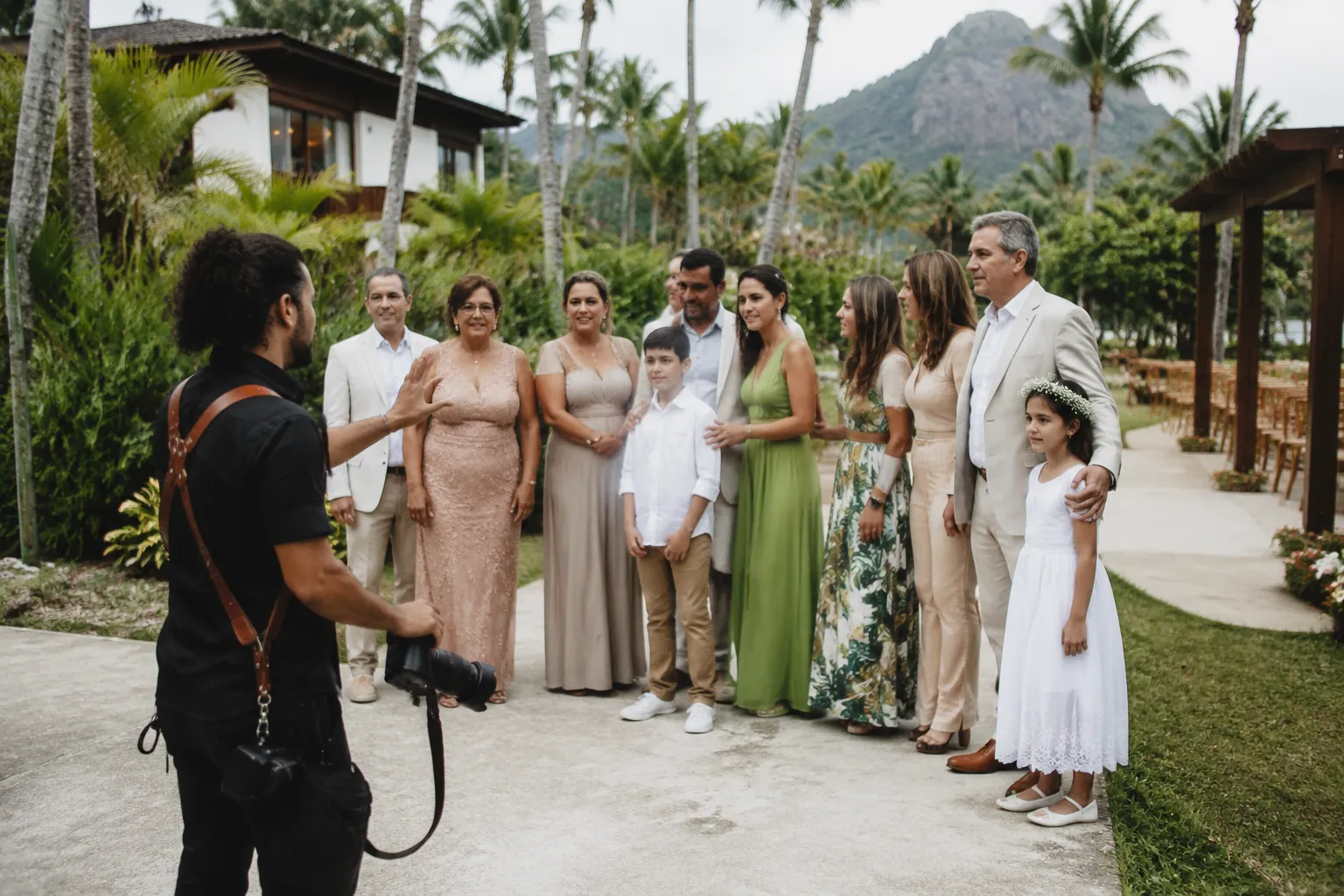
A family wrangler is a trusted person who helps locate and assemble participants. This may be a relative, friend, planner, coordinator, or member of the wedding party.
Give this helper the current relationship key, a short priority list, the gathering point, the photographer’s name, the expected portrait order, and private notes about mobility, children, privacy, and family sensitivities.
The couple should introduce the helper to key relatives before the wedding day. The photographer cannot be expected to recognize every family member or resolve family boundaries during a short portrait window.
Check the Location and Backup Plan
Review the planned portrait location with the photographer and venue. Confirm whether the space can hold the largest group, whether guests can reach it easily, and whether stairs, narrow paths, heat, uneven ground, or limited seating affect access.
Also ask whether indoor portraits are possible, whether another group may pass through the area, what happens if rain or changing light disrupts the plan, and whether the church or venue limits photography locations.
The venue controls access and site rules. The photographer can explain how location, light, group size, and movement affect the portrait plan. These practical questions are separate from cultural expectations and from civil or church procedures.
Brazil-Based and Diaspora Weddings
A Brazilian-diaspora wedding may combine Brazilian family expectations with the practices of another country, church, venue, or civil system. The couple may also adapt the list for chosen family, blended families, multiple languages, different ceremony formats, or relatives joining remotely.
- Which Brazilian relationships should be visible in the portraits?
- Which relatives are traveling and need priority?
- Are madrinhas and padrinhos part of family portraits, wedding-party portraits, or both?
- Are there relatives who should be photographed separately?
- Which family traditions should be represented through people rather than symbolic details?
- Which ceremony or venue rules affect timing and location?
Brazilian and Brazilian-diaspora weddings vary by family, region, religion, ceremony type, venue, generation, and preference. The useful list is the one that reflects this couple’s relationships and the people they want remembered together.
Final Check Before the Wedding
- Names and relationships are correct.
- Priority groups are clearly marked.
- Family-only portraits are identified.
- Parents, grandparents, children, caregivers, chosen family, madrinhas, and padrinhos have been considered.
- Sensitive combinations are noted privately.
- The ceremony context has been discussed.
- The gathering point and family wrangler are clear.
- The portrait location and backup location are known.
- The schedule allows practical flexibility.
- Cartorio questions have been directed to the local cartorio.
- Church questions have been directed to the church office.
- Access, movement, weather, and venue questions have been discussed with the venue and photographer.
Use the Brazilian wedding family photo list as a working map of people, not a claim about what every wedding does. Start with named relationships, choose the combinations that carry personal meaning, then confirm practical details with the photographer, venue, church office, cartorio, and relatives involved.
Sources
- Fotografias de casamento: memórias compartilhadas a partir de acervos pessoais.
- Uma proposição metodológica para leitura de fotografias de casamento
- Casamento na roça: uma análise no município de Porto Firme, Zona da Mata de Minas Gerais
- A fotografia de casamento : uma arte
- Olhares que contam histórias: a fotografia como memórias e narrativas da família
- Imagens negociadas : retratos de família pelas lentes do estúdio Foto Klos nas décadas de 1930 e 1940 em Panambi - RS
- Memórias costuradas: o traje da noiva em fotografias de casamento (1920-1969).