
Planning the Processional for a Brazilian Church Wedding
There is no single Brazilian wedding processional used by every church, parish, or family. Prepare a proposed order, then confirm it with the church office, celebrant, musicians, coordinator, and close family members.
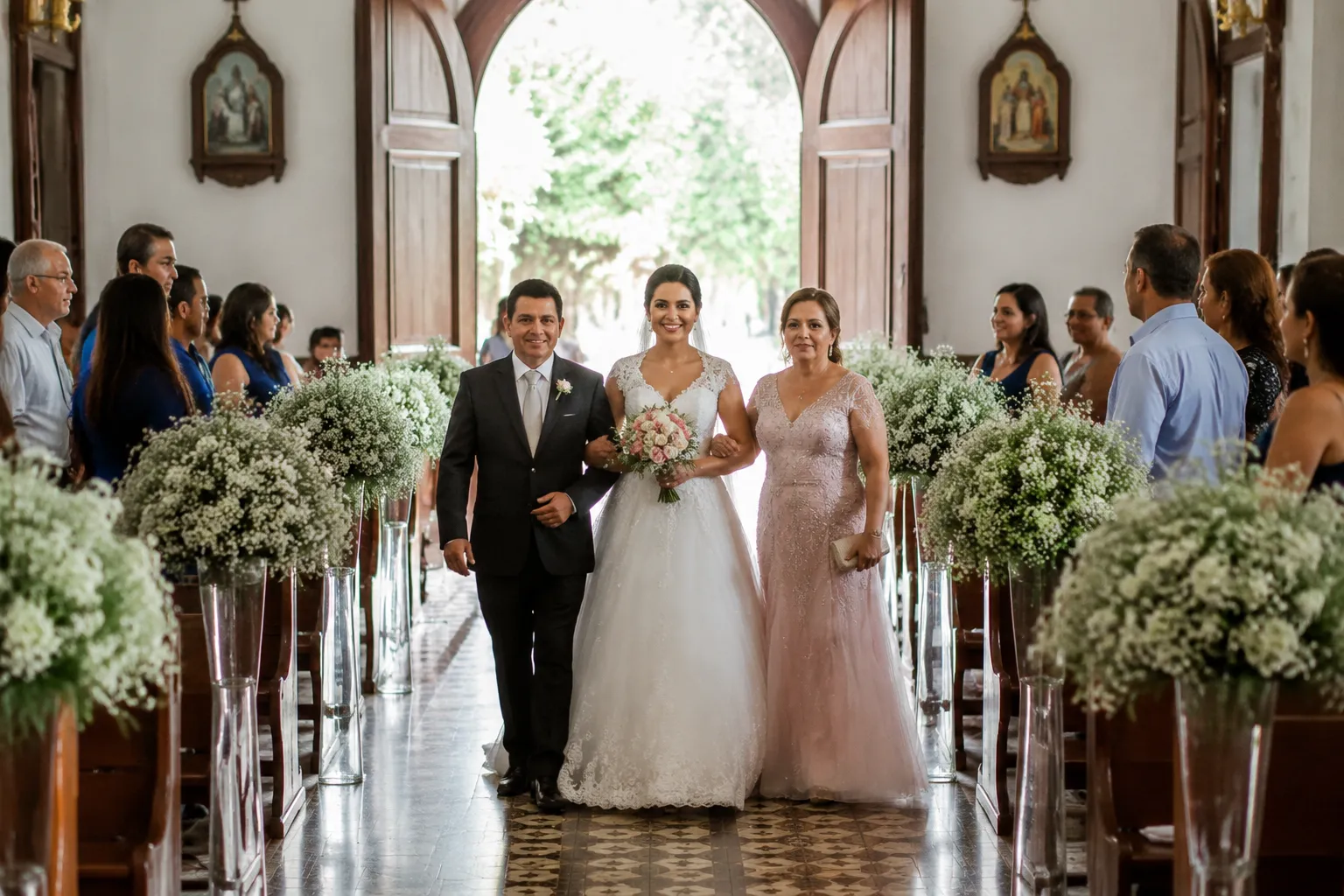
Your plan usually needs to settle who enters, whether padrinhos and madrinhas walk or wait at the front, whether children participate, where each person goes afterward, which music begins each movement, and who gives the cues. Treat these as wedding-specific planning choices, not as a universal Brazilian sequence.
Start With the Parish Structure
In a Catholic marriage celebration, the entrance procession belongs to the opening part of the ceremony. It leads into the rest of the celebration, including the liturgy of the word and the marriage rite. That broad structure helps place the processional, but it does not settle the local entrance order.
The parish may have a preferred arrangement for the priest, ministers, couple, parents, witnesses, attendants, children, and music. Ask the church office or celebrant these questions before giving instructions to the wedding party:
- May the couple enter together, separately, or with parents?
- Should one partner wait at the front?
- Do padrinhos and madrinhas enter, or are they seated beforehand?
- May children participate, and where do they go afterward?
- Which music and instruments fit the parish's ceremony setting?
- Who signals the musicians, and when may the music change?
- Are there limits affecting aisle use, decorations, photography, or rehearsal time?
Write down the answers. A processional involves enough people that verbal instructions can easily differ.
Make a Draft Order
Use a worksheet to discuss the sequence before assigning roles:
| Entrance | Person or group | With whom | Position afterward | Music cue | Confirm with |
|---|---|---|---|---|---|
| 1 | Ministers or clergy | As directed by the parish | At the front | Opening piece | Church office |
| 2 | One partner | Alone, with a parent, or with the couple | At the front | Assigned cue | Celebrant and family |
| 3 | Padrinhos and madrinhas | In pairs, groups, or separately | Seats or designated area | Attendant cue | Parish and coordinator |
| 4 | Children | Alone or with an adult | Front or side area | Children's cue | Parents and church |
| 5 | Other partner | Alone, with family, or with the partner | Beside the other partner | Final entrance cue | Celebrant and family |
| 6 | Couple | Together, where applicable | Ready for the opening rite | Transition cue | Celebrant and musicians |
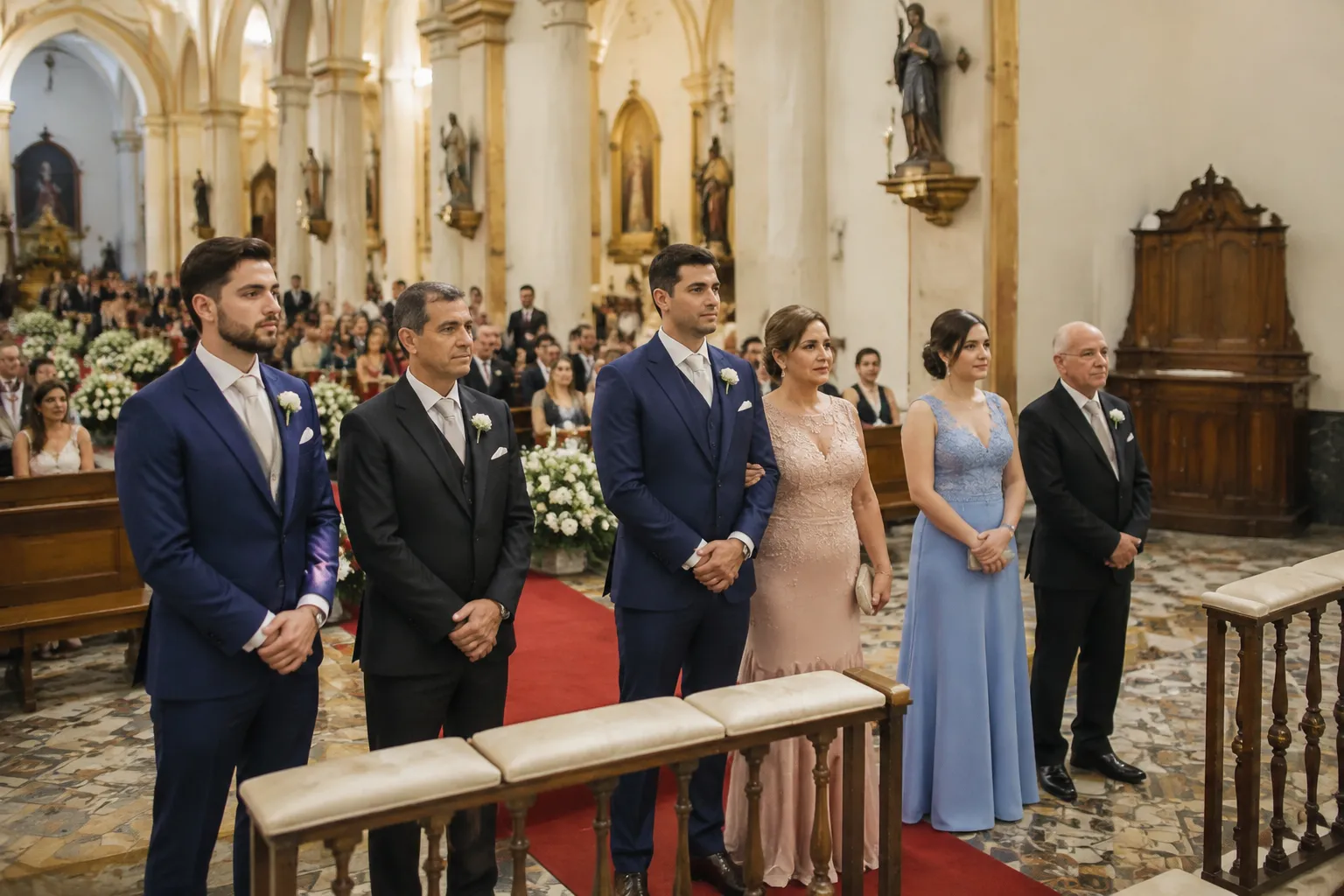
This is a planning template, not a prescribed Brazilian wedding order. Brazilian ceremony observations describe different arrangements, including a groom entering with his mother, attendants waiting near the front, and families negotiating who should be visible in the cortejo. Such examples show variation; they do not establish one national custom.
Choose How Attendants Participate
Attendants enter before the couple
A formal cortejo gives each pair a visible role, but it needs more aisle space and walking time. Confirm the pairings, stopping points, standing or seating arrangement, and whether any combination of attendants is preferred by the families or parish.
Attendants wait at the front
This keeps the entrance shorter and leaves the couple as the main movement through the aisle. It can suit a narrow church or a large group. Confirm where attendants wait, when they sit, and how the photographer can move without blocking the aisle.
Attendants enter in smaller groups
Several people may enter together, or the parish may suggest a shortened arrangement. This can acknowledge a large group without creating a long procession. Record names, groupings, and positions before the rehearsal.
Plan Children's Roles With an Adult Nearby
Children may carry flowers, rings, or another permitted item, but their pace and confidence can change on the day. Confirm whether they may enter, whether an adult accompanies them, where they go afterward, and whether items may be placed or scattered in the aisle.
An adult can hold the rings until the appropriate moment if the church and celebrant accept that plan. Give the musicians a clear cue, and decide what happens if a child pauses, walks early, or chooses not to enter.
Handle Family Expectations Before the Rehearsal
Parents, grandparents, padrinhos, and madrinhas may understand the entrance as a public recognition of their relationship with the couple. That can make placement and visibility more meaningful than the couple first expects.
Ask which relatives expect to participate, whether a parent expects to escort someone, whether anyone prefers to be seated beforehand, and whether both partners want similarly visible entrances. In a Brazilian-diaspora wedding, families may combine Brazilian patterns with practices from the country where the ceremony takes place. Discuss the chosen arrangement as a decision for this wedding, rather than as a test of cultural authenticity.
Separate Music Choices From Music Cues
Choosing songs and coordinating them are different tasks. The church office or celebrant may review the planned music, while the musicians need a cue sheet with operational details:
- Title or description of each piece
- Vocal or instrumental format
- Person who signals the start
- Point where the music changes
- Whether the piece continues to the front
- Plan if the entrance moves faster or slower than expected
The available material does not establish a required Brazilian wedding song, universal musical style, or standard processional duration. Confirm repertoire and cue handling with the specific church and musicians. One agreed person should signal the musicians, and the celebrant should know who that is.
Coordinate Church and Festa Timing
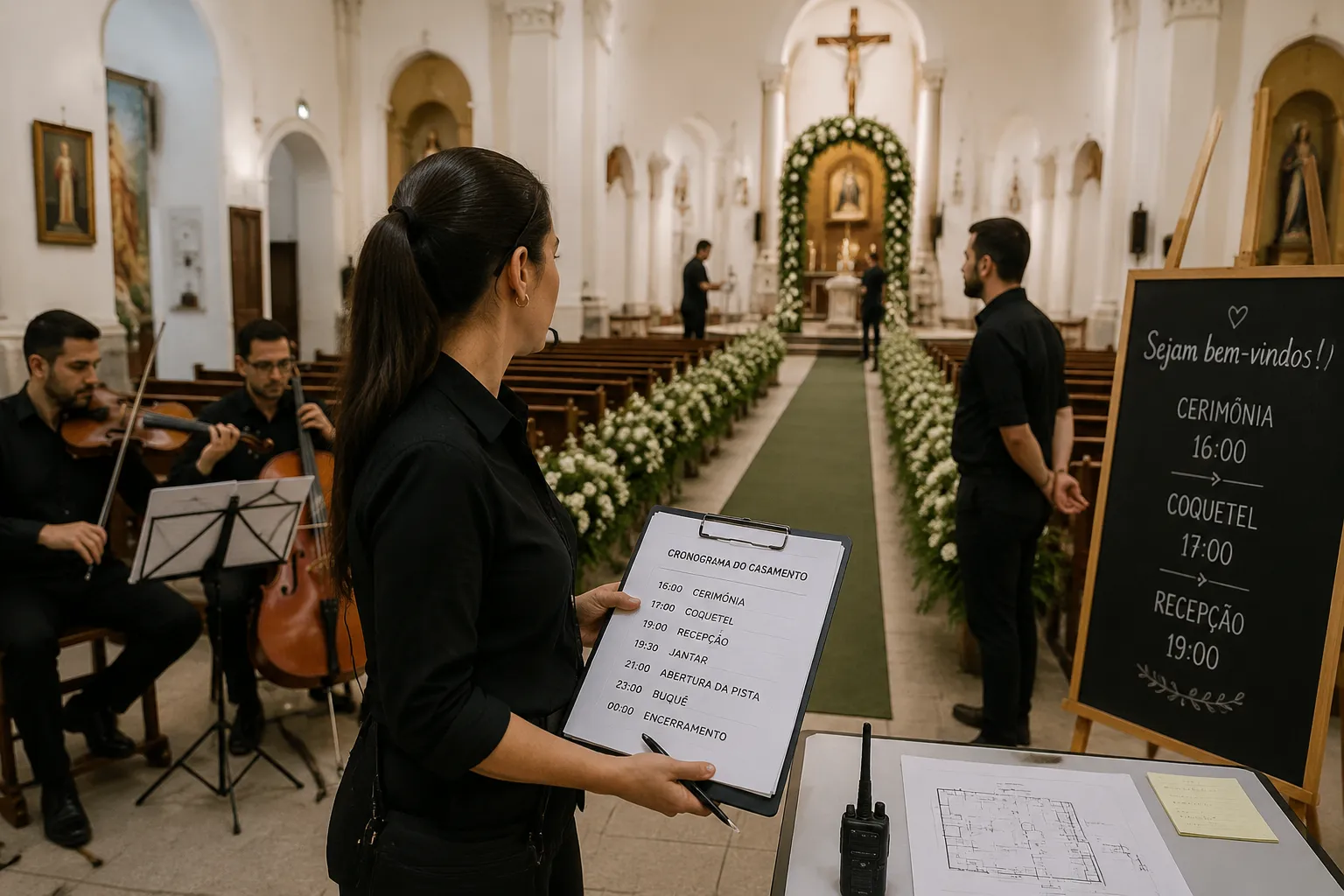
The processional affects photography, guest movement, and the start of the festa. Confirm the church arrival time, doors opening, musicians' start time, ceremony finish estimate, guest departure, photography location, and the venue's arrival or meal schedule.
The ceremony team manages church timing, while the venue manages reception timing. A coordinator may connect both schedules, but the couple should know who owns each decision. Do not promise guests an exact duration when the parish has not supplied one.
Three Useful Planning Scenarios
Couple-centered entrance
The couple enters together, or follows a short sequence of entrances. Attendants may already be seated or waiting at the front. Confirm that the celebrant and parish accept the arrangement.
Groom-and-parent entrance
One partner enters with a parent, separates near the front, and waits for the other partner. This appears in a Brazil-focused observed example, but it remains one documented possibility. Confirm where the parent sits and how the next music cue begins.
Large cortejo
Padrinhos, madrinhas, children, and the couple enter in a longer sequence. This requires written pairings, clear stopping points, enough aisle space, and a response if the route becomes crowded.
Rehearse the Movement
A written order cannot answer every physical question. Walk through the spacing, stopping points, aisle sides, seating changes, sightlines to the musicians, photographer movement, and late-arrival plan.
The church layout may change the plan: narrow aisles, steps, raised areas, side seating, and fixed pews all affect movement. Run the entrance once with the intended music and cues. The purpose is coordination, not performance.
Keep Responsibilities Separate
- The church office or celebrant confirms the ceremony arrangement and parish expectations.
- The musicians confirm repertoire, instruments, and cue handling.
- The venue confirms reception timing and guest movement after the ceremony.
- Parents and close family discuss escort expectations and meaningful roles.
- The couple chooses among arrangements that fit the confirmed conditions.
- The local cartorio handles civil registry questions separately from the church processional.
A church entrance does not settle civil registry questions. Keep those questions with the relevant cartorio and local officials.
Final Confirmation List
- Complete entrance order
- Names and pairings of padrinhos and madrinhas
- Parent participation and seating afterward
- Children's roles and adult assistance
- Each partner's position before and after entering
- Music cues, transitions, and cue owner
- Church layout and stopping points
- Photography and videography movement
- Rehearsal availability
- Church-to-festa timing
- Unresolved family decisions
The practical answer is to prepare a proposed Brazilian wedding processional, then let the specific parish, celebrant, musicians, venue, and families confirm the final arrangement. That keeps the ceremony connected to family meaning while allowing for local practice and diaspora adaptation.
Sources
- Order of Celebrating Matrimony
- Catholic Wedding Ceremony
- ESPACIALIDADE DOS RITUAIS EM CERIMÔNIAS DE CASAMENTOS CATÓLICOS: UMA ABORDAGEM COMPARATIVA ENTRE BRASIL E FRANÇA
- Festa da noiva? Conflito, gênero e parentesco numa etnografia sobre a organização de casamentos
- Brazil - FORMAL ATTIRE FROM ONE SIDE OF THE “BRIDGE” TO THE OTHER: THE WEDDING MARKET AND CLASS AND GENDER RELATIONS INSCRIBED IN THE TERRITORY OF THE CITY
- Support for Engaged Couples in Preparation for a Catholic Marriage
- IUS CONNUBII: Canonical Dimension
- Vestida de noiva – as espacialidades da mulher na cerimônia de casamento: uma abordagem comparativa entre Campo Grande e Paris